Ecopoetics · Cultural History · Ecology

Keystones in the Patterns of Place

A Book About the Stories We Tell with Our Footprint

… even when we insist that we are not telling any stories about who we are, what the world is, and what our role in it might be. It is a book about what stories do to us and what we do to the world because of the stories we tell, and also about what a difference having a footprint can make.

About the book →

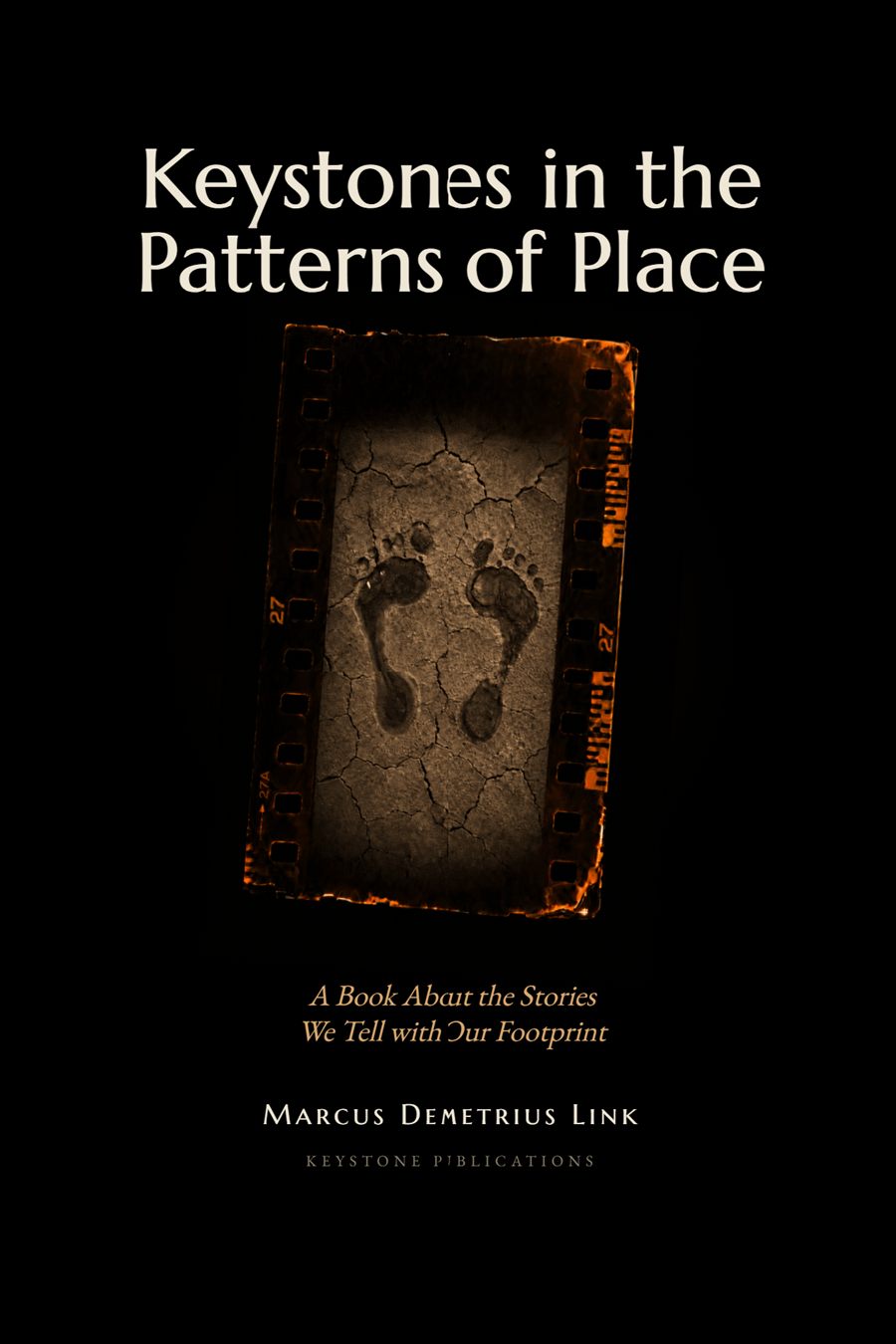
Cover of Keystones in the Patterns of Place: two bare footprints on cracked earth, set within a burnt strip of film
Format
Hardback
Edition
First edition
Publisher
Keystone Publications
ISBN
978-1-0683788-0-5
Date
Forthcoming
Pre-order enquiries →

Reception and reviews

When you describe yourself as a poet, your presentation was poetic. When you describe yourself as a philosopher, it was philosophical. And back of that, a deep systemic thinker.
Claudius van Wyk, Holos Earth Project
That was phenomenal. So much thought-provoking material in there. Absolutely amazing.
Mark van Wyk
One word: wow. It is incredible. For such a young mind to absorb what is going on in that way is incredible.
Jeff Blumberg
A waterfall of images, poetry, philosophy, history, nature, with a touch of technology.
Michael Stock, Holos Earth Academy
Imagination is an organ of encounter, receiving the world, not using it. Very profound, and very Blakean.
Jeff Blumberg, on the book’s central idea

Keystones in the Patterns of Place

A Book About the Stories We Tell with Our Footprint

What kind of storyteller am I with my footprint in the landscapes of life?

In many ways, Keystones in the Patterns of Place is a book of other books and a book of questions.

One of its questions goes like this:
what is it about the story this civilisation of ours, Western culture, tells itself that has brought us to the sixth extinction event, the climate crisis, and the Anthropocene?

My diagnosis is that it has to do with the stories we tell, even when we insist that we are not telling any stories.

It is a book about the stories we tell with our footprint:
about who we are,
what the world is,
and what our role in it might be.

About what stories do to us and what we do to the world because of the stories we tell.

I come to the conclusion that we have it all wrong with what we think of as story.

There are at least five other claims I make:

  • If we don’t have stories, stories will have us.
  • The inner stories of a culture and its outer ecosystem are identical over time.
  • Before we are colonial unto others, we are colonial unto ourselves.
  • Outer regeneration requires inner transformation.
  • Imagination used properly is not an instrument of escape, but the organ of encounter.

Then, one day, it began to dawn on me: I don’t have a choice about my footprint because I am alive. And there really isn’t anything I can do about it. But there is something I can do with it. There is something I can do with my footprint, with the way I live. This realisation changed my life.

Read a sample

The opening movement, the Author’s Note, introduces the central provocation and the autobiographical disclosure the rest of the book builds on.

The Author’s Note

The book’s opening movement: the virus-and-host provocation, the breaking of the Tale of Two Tomorrows, and the autobiographical disclosure the rest of the book builds on.

The sample is being prepared. It will appear here as an embedded PDF you can read in place or download.

Order the book

Available worldwide once published, in hardback, paperback and Kindle, from Amazon, Bookshop.org, Hive, Waterstones, Blackwell’s, Barnes & Noble, or your local bookshop and library. Distributed worldwide via Ingram Sparks.
More previews and insights into the book and its ideas

Questions & answers

What is Keystones in the Patterns of Place about?

It argues that the ecological crisis begins in consciousness. The inner stories a culture tells about who it is, what the world is, and what its role in it might be shape, over time, the outer ecosystem it creates. Drawing together ecology, depth psychology, fractal mathematics, alchemy and hemisphere theory, the book traces how Western culture lost its faculty of orientation across three thousand years, and offers the Compass Rose of Consciousness as a way to recover it. Its central claim is that there can be no outer regeneration without inner transformation.

What is the Compass Rose of Consciousness?

It is a compass rather than a map: it orients, it does not prescribe. Two axes cross at a living centre. The east–west axis is structural, Iain McGilchrist’s two brain hemispheres; the north–south axis is phenomenological, Nietzsche’s Apollo and Dionysus. Each of the four directions gives life at the centre and turns deathly at its edge. The work of orientation is to hold all four in conversation rather than settle into any one of them.

What does the book mean by First, Second and Third Peoples?

The distinction draws on the work of Tyson Yunkaporta. First Peoples keep an unbroken, participatory relationship with the living world. Second Peoples are those captured by the analytical, left-hemisphere framework, who consume what is around them and then themselves. Third Peoples are those who have passed through that analytical world and recovered participation on the other side, carrying the gifts of analysis into a renewed encounter with life. Owen Barfield called this final participation. Second Peoples, the book insists, are second not by destiny but by amnesia.

What is the Tale of Two Tomorrows?

It is the prologue’s name for the two stories a culture tells itself. The Story of No Story denies that it is a story at all and presents itself as plain reality, the world of nation states and borders. The Story of Another Tomorrow knows it is a story but defines itself against the first, and so reproduces the same structure. Both promise a tomorrow, both offer comfort, and neither breaks through into the present. The book is written to break that bind.

Write to me

Send a message

Write to me directly at [email protected] or use the form below. Your name, email and message are used only to reply to you, and are never added to a mailing list or shared. See the privacy notice.