The Role of Spirituality in the Evolution of Consciousness · Part 1
The Role of Spirituality in the Evolution of Consciousness – Part 1: Spiritual Intelligence and Consciousness from Ken Wilber's Perspective
I gave this, the first of two linked sessions, through the Holos Earth Project while thinking aloud towards my book Keystones in the Patterns of Place and the talk I gave on 22 May 2026. It is working ground rather than finished architecture. Some of what I try here reached the book and the lecture, and some I tested, heard back on, and set aside. That testing is how the work finds its shape.
In brief
What happens to spirit as consciousness evolves? Climbing Spiral Dynamics, I kept hitting a question mark above its highest stage, and went looking for an answer in Ken Wilber's map of waking up, growing up and cleaning up. This session follows that map to its edges, where its very completeness began to trouble me, and lands on spiritual intelligence as the heart of the matter.
Slides

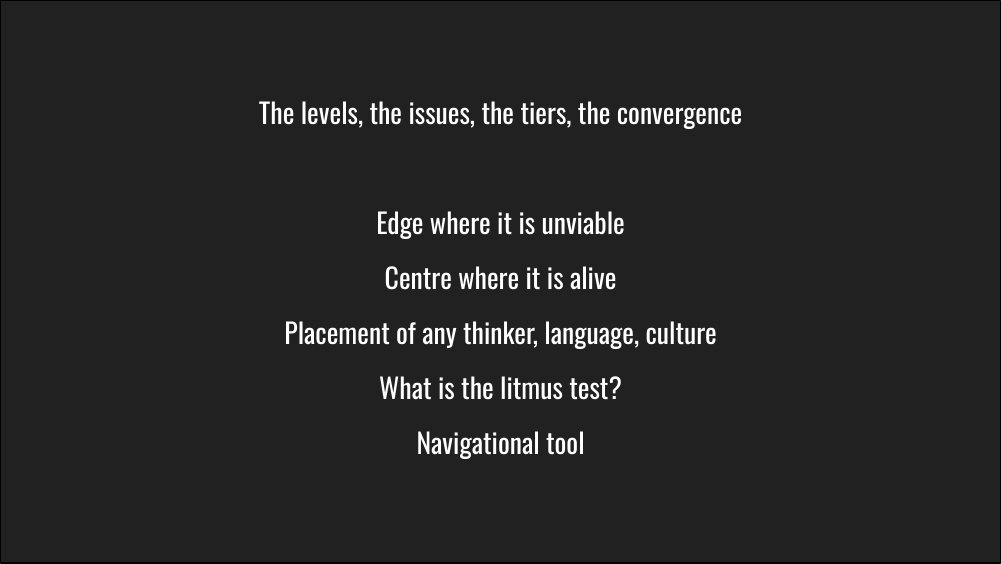
In depth
Climb Clare Graves’s model of developing consciousness to turquoise, and you are handed coral, and after coral a question mark. I understood why: Graves worked only from evidence, and would not speculate. Still, something in me would not settle. I wanted to know what came next, so that I might go there. Not for fantasy. For orientation.
The ache had older roots. I went to university to find something that would enliven me, and met analytical philosophy: language games, reduction, logic. Religious studies handled faith as sociological data, statistics and the floor plans of holy places. I was looking for wholeness. I found fragmentation, and the subject was never contained in its name.
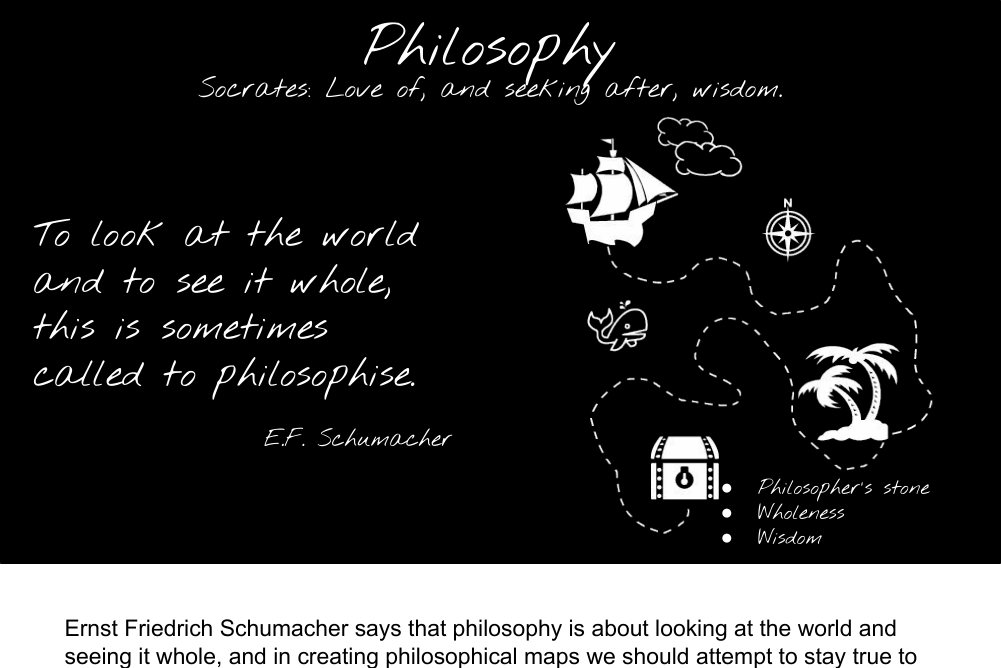
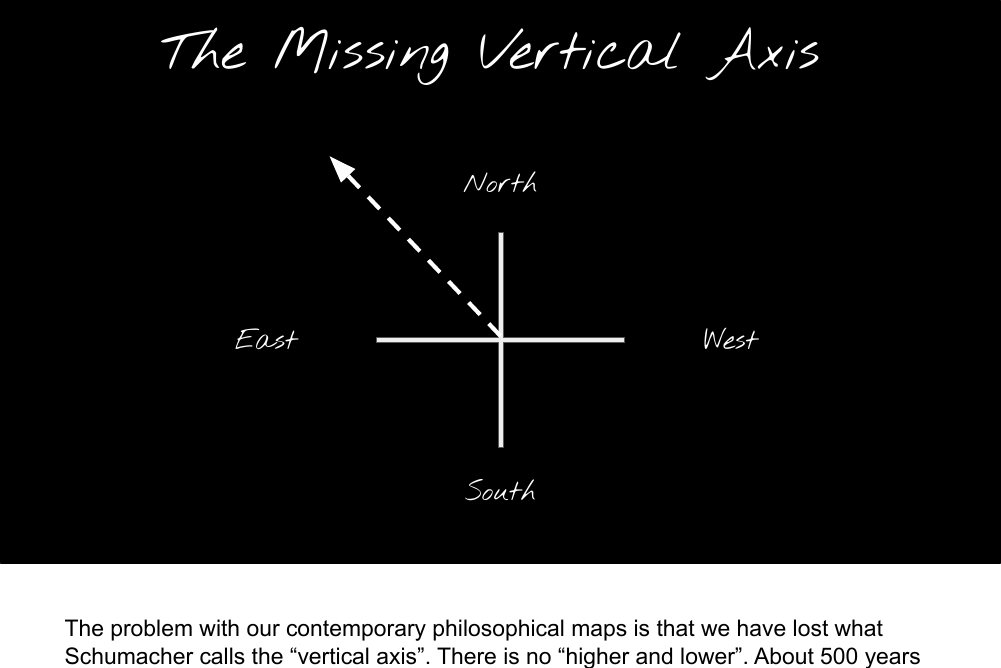
Schumacher gave the loss a name. In A Guide for the Perplexed he calls it the loss of the vertical axis, and offers a definition I have kept ever since: to look at the world and see it whole is what it means to philosophise. Aristotle still had that verticality, the great chain of being. Modernity flattened it.
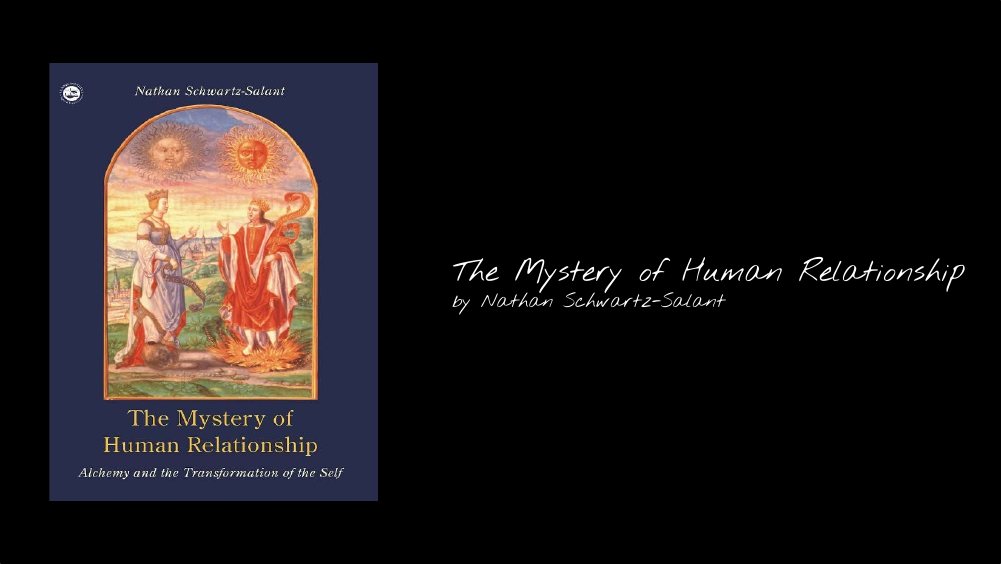
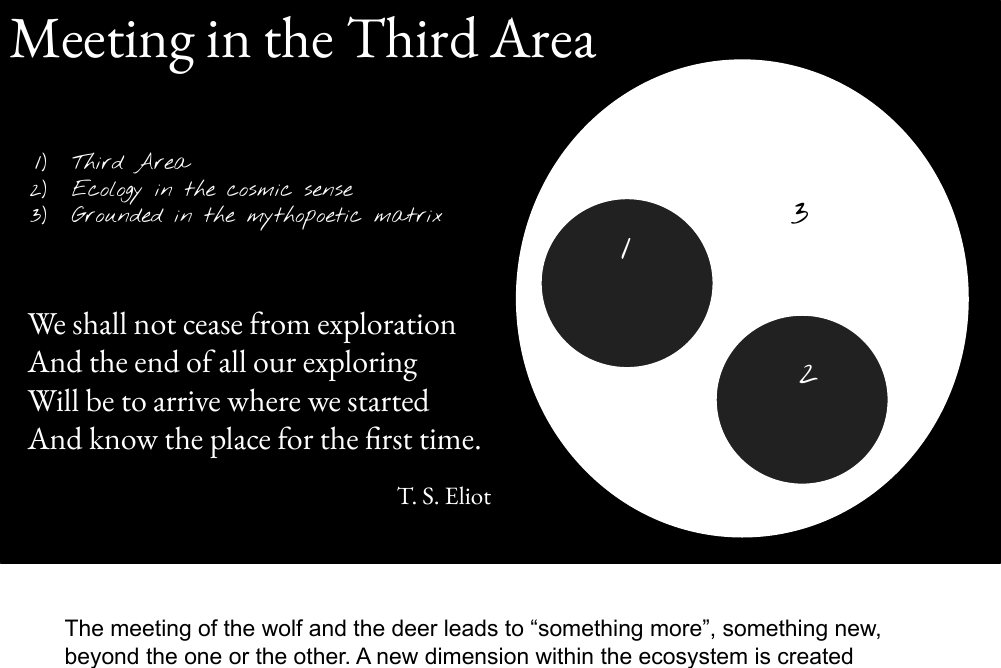
In an earlier Holos talk I had set out the third area, from the Jungian analyst Nathan Schwartz-Salant. When two people meet, a third thing joins them, larger than either and real in its own right: the relationship. It is Jung’s transcendent function, the third charged into being by the tension between two poles. I have since widened it to every relationship I stand in: with myself, with another, with the cosmos. The cosmos and I together are larger than the cosmos and I summed. Underneath lies what I call the mythopoetic matrix, the ground of being conscious at all. Its archetypes are not only the figures of myth. They are space and time, the energy in a quark, the spin of an electron. The same ground that moves us to think in archetypes animates the world, so the stories we live and the stories we tell are one kind of thing, nested like Russian dolls.
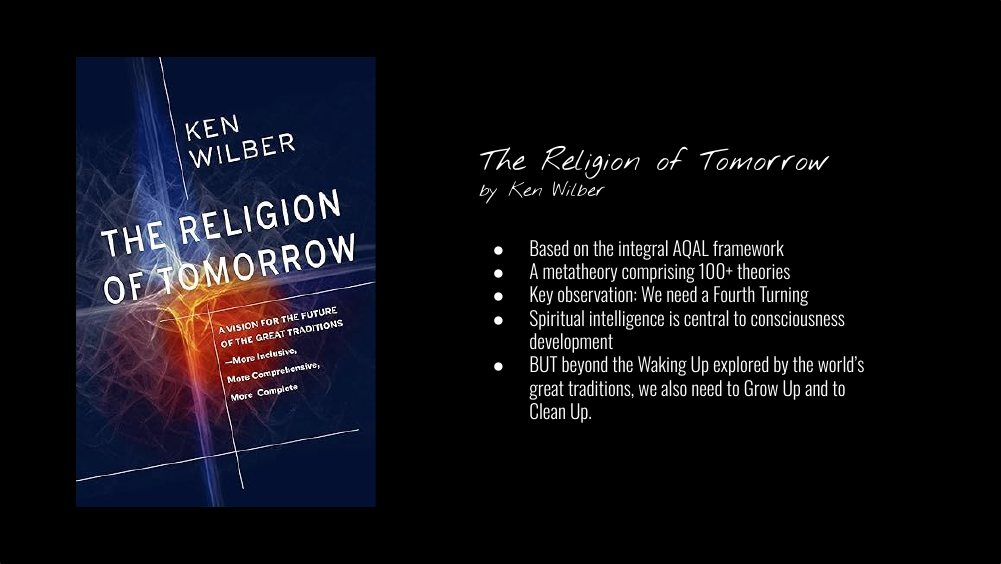
I carried a question to Christopher Cook: what happens to spirit as you climb the levels, and does it simply stay in blue? He sent me to Ken Wilber’s The Religion of Tomorrow, and I devoured it. Wilber is one of the greatest minds I know of, and, humbly, I think he has got something badly wrong. Both are true at once.
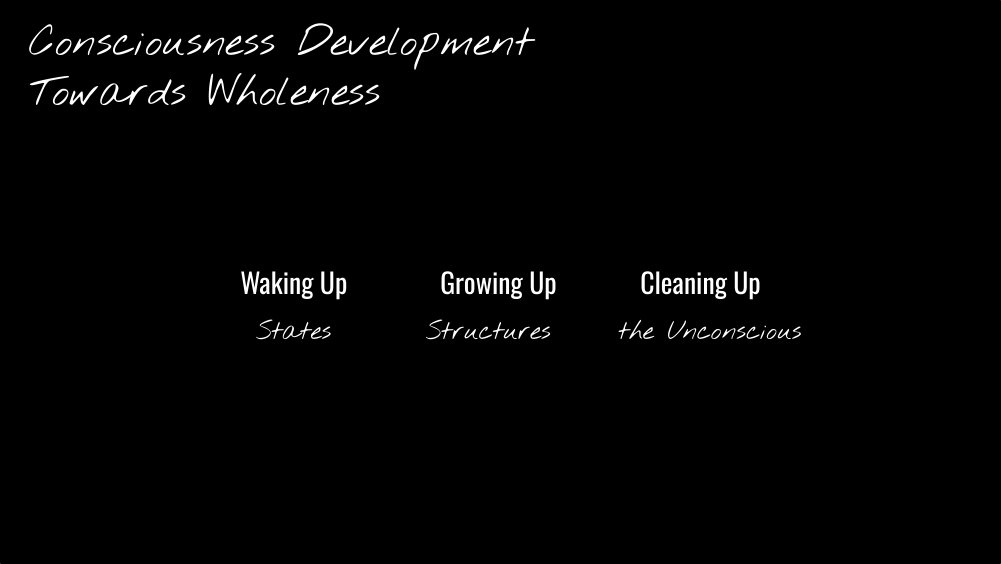
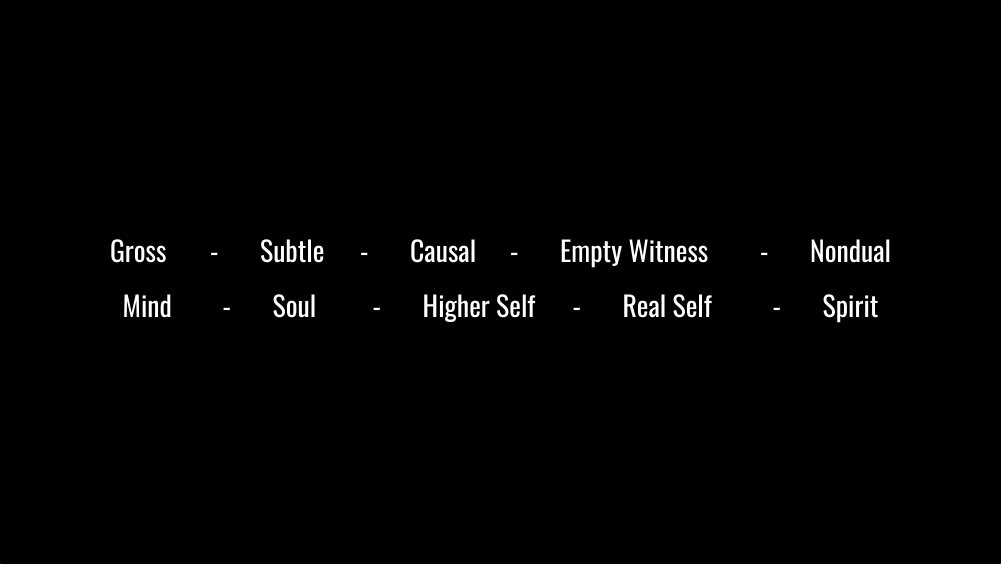
His AQAL framework folds hundreds of theories into one, and applied to religion it argues the faiths have stalled, arrested in time, and need a fourth turning: an integration of what we now know about how minds develop. He sorts spiritual growth into three. Waking up is a matter of states, the gradient from gross through subtle, causal and witnessing to the non-dual. Growing up is a matter of structures, the developmental stages, each transcending and including the last. Cleaning up is shadow work. States and structures, he insists, are independent. You can hold a deep non-dual state on a shallow structure: a man of real enlightenment who is still a misogynist and a racist. A Zen teacher, counting what blocked his students, found four in five were undone shadow. Awakening alone transforms no one.
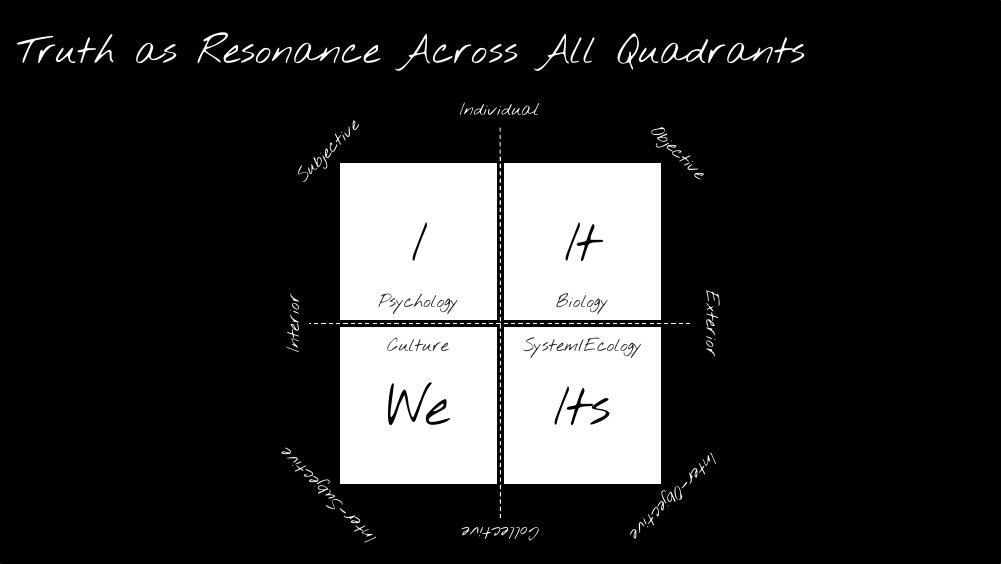
Wilber reopens truth as well. Truth is a resonance across the four quadrants (the I, the It, the We and the systems), and when a thing rings true in all four at once you know it in the gut. Against the relativism that flattens everything into what he calls flatland, a puddle wide enough to mirror all human knowledge and far too shallow to drink, this was depth coming back.
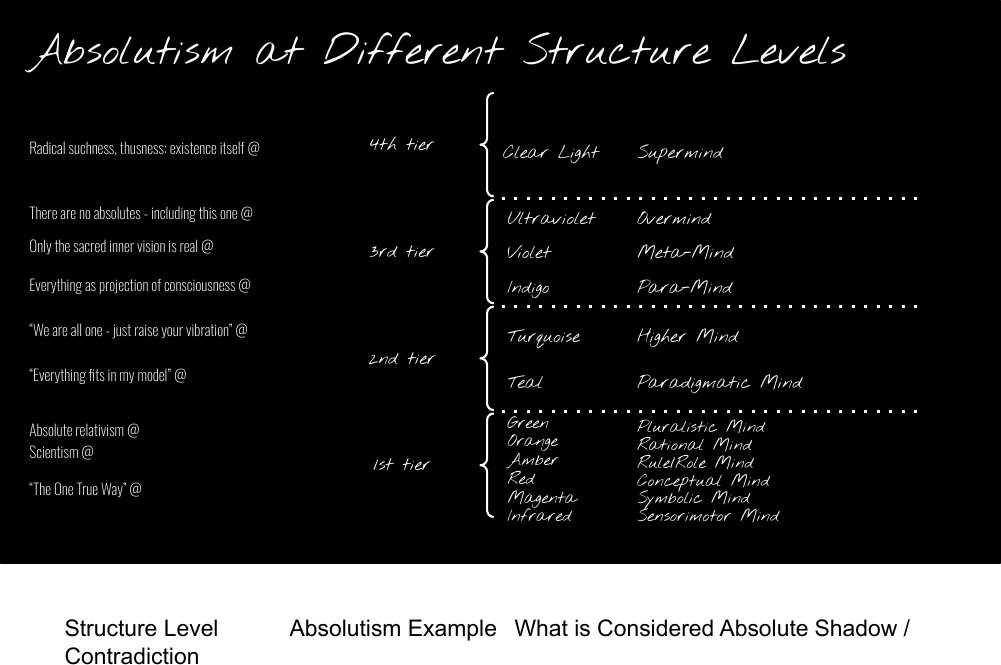
Where Graves halted at coral, Wilber keeps climbing, through indigo and violet and ultraviolet to the clear light he names supermind, and he holds that at those heights the states turn structurally necessary: no supermind without stabilised non-dual awareness. The architecture was extraordinary, and it unsettled me: so complete that any objection could be filed at a lower stage, almost immune to criticism. Too skeletal. Too hierarchical. Too linear. And the questions it never puts kept rising in me: indigenous wisdom, cyclical time, regression as a true movement, the two hemispheres of the brain.
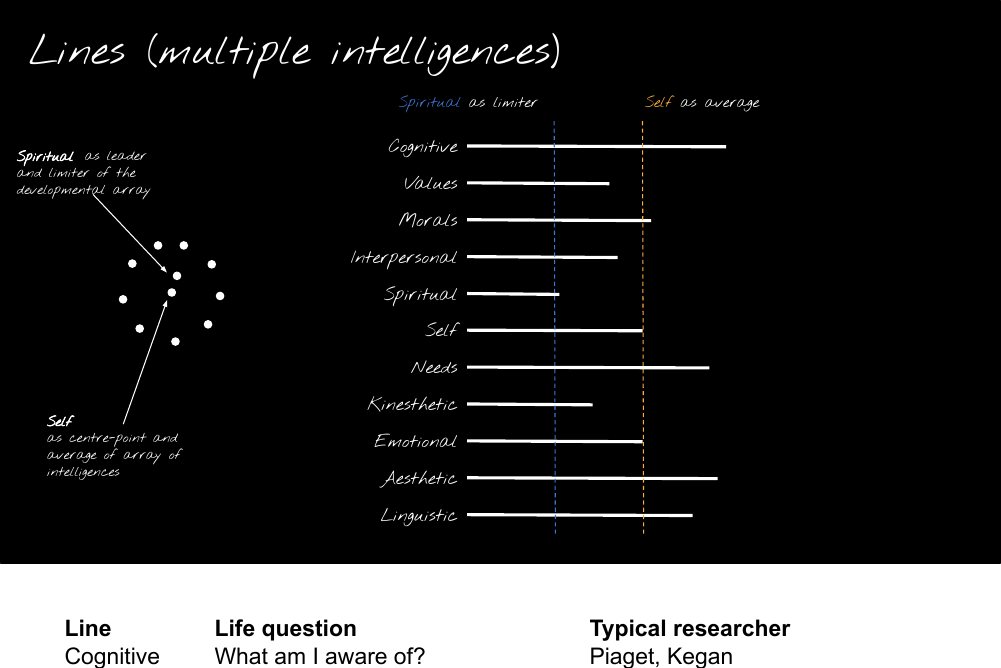
I closed on spiritual intelligence, Wilber’s term and, I have come to feel, the centre of the matter. Of his eleven intelligences it is the one that deals in absolutes; the rest trade in the relative. That is its gift and its danger. It is the source of our deepest convictions, and left out of its own growing-up it will polarise rather than liberate.
This is part one of two. Continue to Part 2: Time, Meaning, Consciousness and Human Agency.
Transcript
This transcript has been edited for readability. Any passage that could not be made out is marked [unclear].
Claudius van Wyk: I’ve been aware that it’s been deep territory that Marcus has been exploring for us, and that that deep territory wants the right kind of space, patience, time in sight. And so, Marcus, we appreciate that. We appreciate what you’ve been doing, and we’ll have a conversation about how best to optimise it, for whom and in what way, what you have to share with us. So without ado from me - I see Ken is there - I’ll hand over to you.
Marcus Link: Okay, brilliant. Thank you so much for this unofficial meeting. I think I’m generally in danger of biting off more than I can chew, and I’ve been trying to break this down into smaller chunks of a journey, so that I can explore it in a more comfortable setting, with folks that I know are more friendly disposed. Even if everybody’s friendly disposed, in a wider setting it’s just easier, I think. And you will find that this is not in any way smooth. This is still very much, on the material level, something that is expressing itself, but in process.
I couldn’t hurry it, because I can see where it’s going, and seeing where it’s going isn’t the same as doing it or going it. It just took a bit more time, and I hope that the shape and size of it somehow comes through here. I haven’t got a fully prepared script, which is very unusual for me. I’m going to take a leap of faith and work with the material. I’ve prepared some slides, as usual, but I haven’t got a long bit of text to go with it, only a few helping notes occasionally.
There are several beginnings that I’m going to take you through, necessarily, because it’s like a nested beginning. I just want to start with a framing of how I arrived here, before there’s any slide material to distract you.
I’ve really enjoyed a deep dive, through Claudius and through Christopher Cook, into Spiral Dynamics. We’ve been to workshops together, we’ve explored it together in all sorts of ways - a truly valuable framework - and we’ve explored it as part of the Holos project. Once you get to turquoise, the only thing that’s articulated is coral, and then there’s a question mark in the middle, certainly in Christopher Cook’s work. The point is that it’s for you to work out what that next thing is.
Now, I have since found out that the reason it is so is because of the way Clare Graves went about things. He worked from whatever he deemed to be evidence, and then he worked out the psychological profiles on that basis. So his theory is a developmental theory. It’s about how human consciousness develops over time, to put it really briefly. You’re familiar with it: there are different colour codes, and then there are different levels, and he talks in particular about something he calls first tier and second tier. A lot of the Holos project, implicitly or explicitly, is positioned around exploring that transition from first tier to second tier.
I found myself unable to articulate my displeasure with Graves’s model. This is not a critique of Graves - it’s fantastic - but there was a displeasure in the coral question mark. It felt a little bit like I wanted to know what comes next, in a way, so that I could go next. That’s not what Graves has to offer, and that’s not what he wants to offer. So, just to be really clear, I know what’s on offer, but something in me wanted something else.
So that’s one aspect of this. The other aspect is something that’s been bothering me pretty much all of my life, which is the relationship between spirituality, religion, and consciousness.
I studied philosophy. I made the terrible mistake of leaving Germany, from a philosophical perspective. I learned to love philosophy in Germany, but I actually studied philosophy as an undergraduate student in the UK, and that meant I didn’t study philosophy - I studied analytical philosophy. That’s a very different subject from what you expect when you have a Continental background. I have since come across people who have that same Continental background I have, and who at UK universities have not studied philosophy but theology, in order to find what they were looking for. It’s a very interesting aspect.
Now, the other subject that I studied was religious studies. In the UK, religious studies is about as lifeless as it gets, when you’re talking about belief systems, and what motivates people, what’s their faith and so forth. It’s all about statistics, about behaviours, about the layouts of holy places. It’s about the rules, the dogma, as it were, in order then to be able to analyse statistically, in a representative way, whether somebody is a Christian or not. And for me, the inner narrative - as in, this is an example, the Christian - in religious studies I studied even dialectical materialism, also known as Marxism, because that’s also a religion, apparently.
So where I’m coming from is the question of - today I know the expression “fragmentation” for that - where is the wholeness in this fragmentation? And why did I not meet, in the subjects that I was studying, that which I was trying to find? If I answer from a sense of deep gut feeling, what I was looking for was something that was going to enliven me, and instead I found something that deadened me. The subject was not contained within the subject title. This was just a vignette of experience. So this has been going on for me a long time.
In two Holos talks preceding this - this prep talk for, hopefully, a proper talk eventually - in those two preceding talks I shared a few things that have accompanied me, that I’m bringing back here just to help you follow me.
The first one is this slide, in which I talked about E.F. Schumacher. Ernst Friedrich Schumacher, the namesake of Schumacher College and so many worthwhile projects, wrote two books in particular: Small Is Beautiful, and A Guide for the Perplexed, which is named after a philosophical treatise by a chap called Maimonides, of ancient Greek extraction, who also wrote a book called A Guide for the Perplexed.
Schumacher reveals, in A Guide for the Perplexed, his search for a philosophical map. The search for the philosophical map is essentially about this: something’s happened, we’ve lost something, I want to have it back - and what I want to have back, he says, is wholeness. Because the philosophical maps of our current age, they have everything but not wholeness.
He sets out in what I think is a fairly awkward book. His writing wasn’t quite up to the task he set himself, but he was a knight nonetheless, a knight of the Order of Philosophy, and he fought gallantly. He has a few definitions in the book without being clear that they are definitions, and one of them is to say that to look at the world and to see it whole is sometimes called to philosophise. That’s a brilliant, beautiful definition of philosophy that I’m very happy to go along with. And the important tool to navigate the world in philosophical terms, and to see it whole, is a philosophical map.
On my little map, we set out with our three-masted man-of-war - let’s say it’s the fifteenth or sixteenth century - we’re on our way, and we’re trying to find treasure, which could be different for every person. Let’s just say what we’re looking for is wholeness, or wisdom, or the philosopher’s stone, as it’s often described in the European heritage.
Here’s just a photo of the book. Another phrase that Schumacher uses for what’s happened, certainly in the West, in his analysis of the situation, is that we have lost the vertical axis, or the vertical dimension. Schumacher’s approach to this whole thing is to take us backwards in time, to a golden age of philosophy when we still had the vertical axis, and he takes us all the way back to Aristotle - not Plato, but Aristotle - who articulated a treatise on the nature of the three souls.
So we have the dead realm of the minerals. We have the realm of the plants, we have the realm of the animals, and the realm of the humans. These are three different souls. We can talk about what’s beyond and below, but we know these four things for certain, and in olden times this was sometimes called the great chain of being, so that you could see the succession: from the dead realm of minerals, to life in plants, to consciousness in animals, and to self-awareness in humans. These are the attributes that he positions along this, and he sees it very much like a Russian doll, a Matryoshka of infolded wholeness, as Smuts might say.
Then, in another talk - I’m just going to skip forwards - my second talk, on the human being as a beneficial keystone species, I talked about many things, and one thing in particular: this concept called the third area. The third area is an articulation by a Jungian psychologist called Nathan Schwartz-Salant.
Nathan Schwartz-Salant is very much concerned with the nature of human relationships. His practice is all about, mostly, let’s say, failures in romantic relationships - and let’s just call them the inevitable failures of romantic relationships, as he says, because there are two people involved, two entire universes, and they think they can get along with each other. So let’s have a look at how we can understand this better by going back in time. Skipping back before we had a scientific viewpoint of things, we go back before we were looking at things through an objective, third-person, out-there analysis of the outside of things. Let’s go to the inside of the subjective experience, and try to make sense of that. He transposed, if you want, the world of alchemy onto the work with relationships.
The way he formulated that was that every relationship between two people involves not just the two people, but a thing that is bigger and larger than the two people, which is their relationship. We must now understand the two subjects in the relationship as the objects of that relationship. This creates the third field, and it’s congruent with Carl Gustav Jung’s idea of the transcendent function, which is that in any paradox we don’t reduce the one end of the paradox onto the other, or eliminate one so that we’re just left with one. Rather, what we want to do is find the third that is activated through the paradox, through the energy that exists between these two poles - much like a battery charges something. You don’t just want plus or minus, you want the electric field. And in that electric field we contend with some conscious material and a lot of unconscious material.
This is quite important for things that will come later. In my talk I didn’t just talk about psychology - in fact that was the smallest part of my talk, I almost skipped over it - but nonetheless the third area is really important, not just for a psychological relationship between two people. I’ve since worked with this third area and expanded it, in my articulations to myself, as a way of thinking about any relationship. My relationship with myself is a third area, the relationship with another person is a third area, and my relationship with the entire ecology, in a cosmic sense - the world, if you want - is also a third area. Interestingly, what happens when you look at it like that is that the entire cosmos plus me is a thing that is larger than the entire cosmos and me put together. It’s our relationship. That’s just a fascinating way of thinking about this, because of what it does: it shows you, not just conceptually but in your senses, because if you had any reaction in you, like a smile or something, it will have resonated with you in some way, and this resonance is really what I’m trying to trace here.
So: the third area, ecology in the widest cosmic sense. And then, underneath all of this, is something I’m just going to call the foundation of our ability to be conscious at all, rested in the mythopoetic matrix. Now, that might be a term that just sounds like gobbledygook. The way I’d like you to understand it is that the mythopoetic matrix includes anything that we might call an archetype. By archetype I don’t just mean archetypes in myths, or in the Bible, or in the human psychological sense. I mean archetypes like space and time. I mean archetypes like the energy that’s contained within quarks and animates electrons to spin around the nucleus of an atom. I mean foundational things. Because one of the things I’m very clear on is that the same thing that motivates us to think and experience in archetypes is the same thing that actually animates the entire world. There is a foundational layer - let’s call it the mythopoetic matrix. The reason that’s great is because the stories that we live are the same kind of thing as the stories that we tell. They are both founded in the same energy constructs. In fact, they’re just replicating themselves, like Russian dolls. It’s a nested phenomenon. And, to just bring Jung in here -
This led me to a chance conversation with Christopher Cook, who I already referred to. I was travelling with him, actually, because I have quite a lot to do with him for business these days. We had a joint trip with lots of time to talk, and I had prepared my question well, with a preparatory conversation with Claudius. I had said to Claudius, my conundrum with this whole Graves phenomenon is, I want to know what happens to spirit as you go up this ladder of levels. Does it just stay in blue? What happens to it afterwards? Why does religion happen there and not somewhere else?
And Claudius’s advice, in short, to save us all time, was: have a conversation with Christopher, I’m sure there’s a lot more than you might suspect. And interestingly, Christopher said, “Let me think about this for thirty seconds.” He thought about it for thirty seconds, and then he said, “You need to read The Religion of Tomorrow.” And that was it.
We didn’t talk about the subject much more, because he said, read the book, and then we can talk about it. So this book - I’m just going to show it to you, it’s got a screwdriver in it as a placeholder - this is the size of the book. It’s a Bible. It’s bigger than the Bible. This is a substantial piece of work. I have devoured it. I have listened to it on audiobook, I have read it faster than I have read some shorter books, because this really was what I was looking for when I went to university - when I studied philosophy as analytical philosophy, and religious studies as some sociological inquiry, when I asked many questions in the Holos project.
There is something deeply profound in this book, and at the same time something that totally repelled me. And this talk that I’m preparing with you here has its genesis in reading this book, thinking about it, being super inspired by it, and also thinking: Ken Wilber, you are one of the greatest minds of all time, and I think, in a very humble way, you’ve got something badly wrong. I don’t say that lightly - I say it with the greatest gratitude, and I also say it with a sense of, wow, we can live and make such statements, and no thunderbolt comes down from the heavens, only the one from the inside that then makes you start to actually formulate what’s my problem.
But before I can help you see the same problem I had with Wilber’s work - and just to be fair, it’s not so much a problem - rather, once I saw the whole thing, I felt that there were a few mistakes he’d made on the way, and I want to show you those. But only once I’ve taken you through what I’ve seen in his work before I had the criticisms, so that we’re on a sort of level playing field. I think it can be quite informative, because I haven’t met that many people yet who have taken the whole thing in in that same way. And if you can get anything from this, I’d really hope that the ways he talks about consciousness can, at least in a half-formed way, come across and mean something to you.
Most importantly, this book, The Religion of Tomorrow, is based on Wilber’s astonishing work of integrating hundreds of theories into a meta-theory which he calls the AQAL framework. So far so good. You’ve probably heard this before and worked with it. But I want to unpack this in a specific way, so I’m going to go to the basics.
So, the AQAL framework: hundreds of theories. And then he applies this to the subject of religion and spirituality. He makes a key observation, which is that most - not all - faiths, all religious systems, they’ve been arrested in time for quite a while; some of them a hundred years, some of them maybe even a thousand years. They need what he calls a Fourth Turning, and that’s a phrase he borrows from Buddhism. He was, interestingly, a practising Buddhist, and many people know him as an intense Buddhist practitioner of some thirty, thirty-five years. He stepped out of that practice, and he’s much more integrative these days. He now wears a wig because he wants to have hair again, and his own hair doesn’t grow, and he’s got some very strong Christian elements in his work as well, which is very interesting. So there’s a broadening of his perspective that’s happened. But Buddhism is foundational for his epistemology. So his knowledge system borrows a lot from Buddhism, and so he borrows this term, Fourth Turning. What it really means is that another big change in the way that we look at the world must happen, and it must happen because our knowledge systems have developed at such a pace that it’s no longer acceptable, he says, to follow a dogma without integrating into it these new forms of knowledge. Because you have a big problem when you don’t, and I’ll tell you in very basic terms what that problem is.
One of the aspects that he goes to town on, and it’s absolutely delightful, is the positioning of something he calls spiritual intelligence as central to consciousness development. So we’re immediately going to the centre of these questions I had about consciousness: where it comes from, how it works, what’s its relationship to religion and spirituality. Now, you could, in a very shallow or brief way, say that the domain of spirituality and religion is often something we might refer to as waking up: we wake up to something higher, for lack of a better word for now. But he says that what we need to bring in, to make the Fourth Turning happen, is an understanding that we now have of how we grow up and how we clean up.
And with this language - wake up, grow up, clean up - I had my first objection to Wilber. He has this capacity to take really big things, and beautiful language, and then suddenly come up with this marketing language of, you know, wake up, grow up, clean up. When in this book you use that language, it felt just a little bit disappointing, as though he’s trying to work a little bit too hard at getting people to read his book who won’t read his book anyway.
So what are we talking about when we talk about wake up, grow up, clean up in Wilber’s sense? Consciousness is always about a development towards wholeness, he says. That’s, of course, what much religious, meditative, contemplative practice is about: you’re trying to expand your consciousness, and this might be expressed as tuning in with God, or recognising an inner field. There are lots of different ways of saying it. But with Wilber we now have this language of wake up, grow up, clean up, and what he’s talking about is that there are three foundational aspects to consciousness that we need to recognise, not just waking up.
In waking up, we’re concerned with states - consciousness states. For example, waking is a consciousness state. Dreaming is a consciousness state. And, to skip right to the end of it, we’ve often heard of something described as non-dual, or unity consciousness. I’ll explain a little bit more about that in a moment. In fact, there are five states of consciousness we can work with. There are more, but it helps to just get a sense of the steps along a gradient.
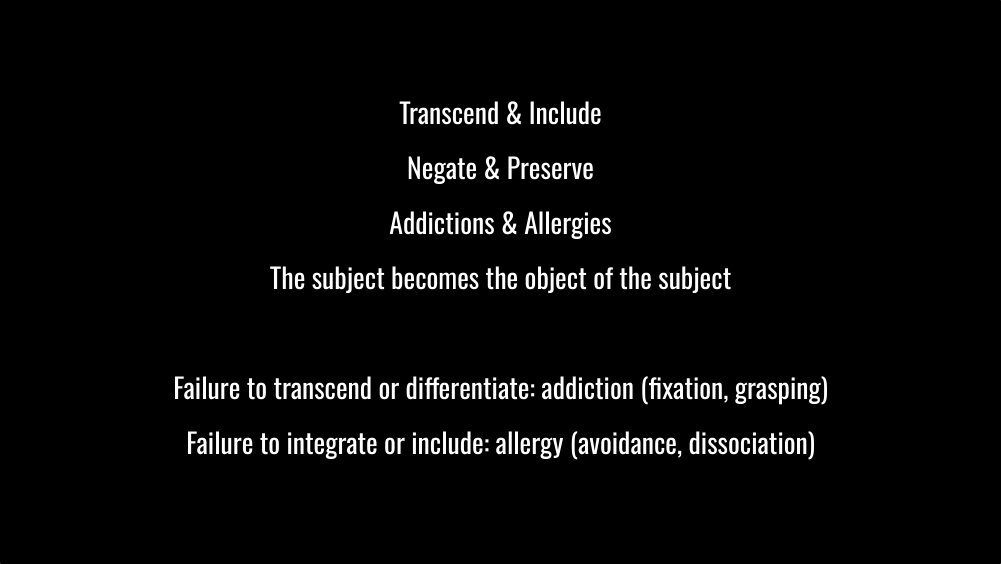
Then there’s growing up. This is the work that most people know Wilber for, which is the whole idea of developmental psychology, developmental consciousness, broken down into stages that have a transcend-and-include mechanism with which we uplift ourselves in an evolving way. And even just the practice of exposing ourselves to it - I think Wilber’s right in this - when we think about it, it has an effect on us which is a growth effect. We grow up as we consider the structures of consciousness development.
But, he says, here’s the real big problem, and I’ll go into it in some detail in a bit: you can arrive in a situation where you are what he calls a deep state. So you might have a non-dual, general state of existence as an enlightened mind. But if your structure is shallow, you are still a misogynist, a racist, you shout at people, you have no understanding of cosmic-centred consciousness. You are possibly a slave to an egocentric, or maybe an ethnocentric, or maybe even a world-centric structure. But as long as you don’t recognise that there are structures, you will be arrested, despite being enlightened. That’s a really powerful point to consider.
And the third rung, the third aspect of this work of consciousness towards wholeness, is the work that we sometimes know as deep psychology. He calls it cleaning up. It’s essentially the confrontation with the unconscious, or, in more colloquial language, the confrontation with the shadow. Wilber says that eighty per cent - this is a statistical fact he quotes from a psychology colleague, a psychology professor who is also a Zen master, who statistically assessed the issues that his Zen students have in their practice - he came to the conclusion that at least eighty per cent of the problems in the progress with the meditation work is not actually a problem of structure, understanding, or state movement, or state dynamics. It’s the fact that the undone shadow work gets in the way of all the other stuff. And if your religious practice is not aware of the possibility of psychological structures that determine your consciousness development, or doesn’t engage in the confrontation with the unconscious, you might end up with things being said such as, well, then you don’t love God enough, or you need to meditate harder, or you need to say more Hail Marys. The problem is that you’re probably preventing the progression of consciousness rather than enhancing it through those kinds of measures, however enlightened you are. I’m just going to carry on.
Before we go much further, I wanted to bring up this probably familiar set of four boxes, that is normally where the discussion of the AQAL framework starts and ends. But I want to bring it up from the perspective of: what is truth? So in the first tier, which is where most of our public life happens, we often find that truth has something to do with, say, evidence, or it has to do with - when we’re in the mostly Western world - science. So science is somehow the arbiter of truth, and it has a particular protocol that worked really, really well during Covid, if you remember. Sorry, that was a joke.
There are lots of different ways of accessing truth, but the one that Wilber puts forward is that truth is something we can feel at a very deep level, and what we feel is a resonance, and that resonance hits us across all four quadrants of our existence. So this is just a framework, it’s just a concept, but the fact that he lands it in the feeling that you have in your gut when something strikes you as true, and that that truth is one of a coherent resonance between yourself and other people and the world at large, across the four quadrants of his breakdown of what reality is and how we engage with it, is very powerful. I found that really beautiful.
So, just a brief refresher on it. In these four quadrants we have, in the top left - or sometimes called upper left - we have “I”. “I” is me on the inside. This is my subjectivity, and the domain of that, to be short about it, is psychology. Much of psychology is actually over on the “It” side, but let’s just say this is about my interior life, my inner world, the things that aren’t visible on the outside but I can see them on the inside. The two upper boxes, they are about the individual existence of things and people. So in the top right is “It”, and the domain that studies it is biology, for example. There are lots of other domains that do that too, but I just want to keep it simple. This is an exterior way of looking at it, whereas psychology and “I” is an interior way of looking at it.
When we fold down to the boxes at the bottom, we have in the lower left the intersubjective realm of “we”. So I come together with lots of other people, and then we have a culture. This is the interior domain of the intersubjective aspect of life, which happens on the interior side, which is things we do together in big and small ways. We expect dinner at seven, for example, is just a very basic way of culture. But it spills over into systems on the other side, because everything that happens on the inside has an expression on the outside, which is framed as “Its”. It’s the interobjective realm of systems, and ecology, in my view, in the cosmic view, is the widest system. The universe is an ecology, and it’s a system, and it’s made up of lots of “Its” that also have an inside. So when all of these things are quivering with excitement, then one way of experiencing that is that you’re just standing in the truth of something. And if they’re quivering in a different way, and you really know, “yuck”, then it’s the opposite. That, to me, feels like a very good way of defining truth.
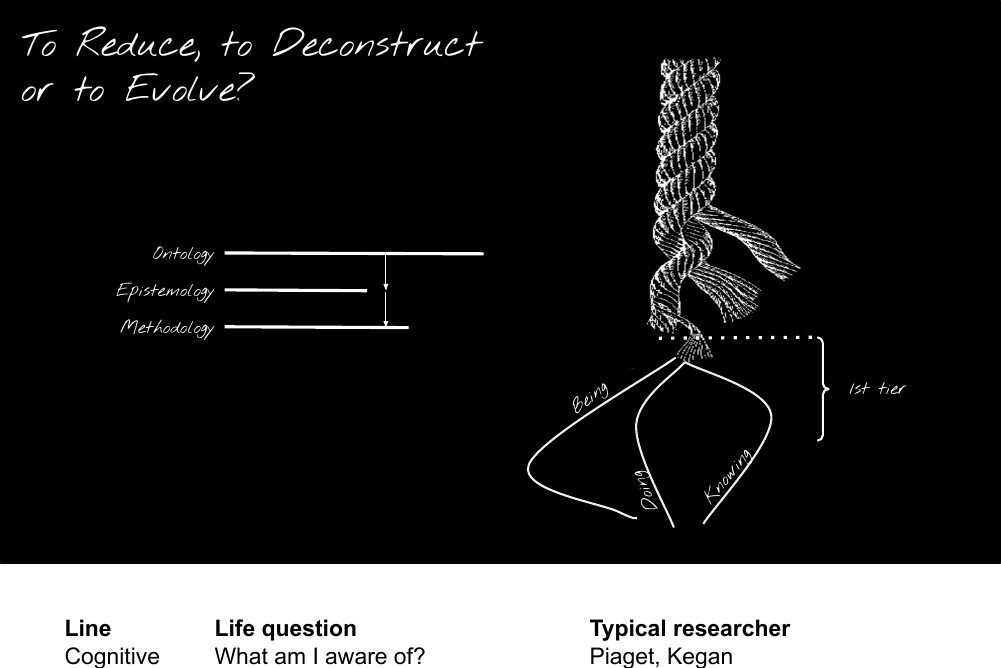
Before I go into some more of the structure of what Wilber talks about, I want to briefly consider these three phrases: ontology, epistemology, and methodology. These are three terms spouted about in analytical philosophy with great abundance, and they make something very simple very complicated. Essentially, we’re dealing here with the realm of knowing, or epistemology; with the realm of being, or ontology; and the ways of doing stuff, methodology. And there is, unfortunately, in the analytical philosophical school, and in our culture at large, this drive to believe that truth and reality are a result of reducing one thing to another. There are these two phenomena, but one set of phenomena is more true than the other, and we will reduce the one to the other, and then we’ve got a beautifully simple model. This is sort of Descartes at his best: if you don’t understand it, just stop considering it and go back to the more simple thing.
A more recent proponent of this kind of thinking is Edward O. Wilson, who was a brilliant biologist. You can’t see the book because of my filter, sorry - he wrote this book called Consilience. It’s a terrible book, although I have great admiration for him in his role as a biologist and ecologist. In his book he basically talks about how he is looking forward to the day when science has reduced the humanities to its own level of understanding. The reason I find it a terrible book is because that’s just such an anti-human, anti-life, anti-cosmic thing to want to do.
The cosmos doesn’t evolve through reduction. Neither does it evolve through deconstruction, which is the other major philosophical school of the twentieth century, which you will remember from Graves’s work: green is all about postmodernism. Reductionism sits a little bit in rationalism, modernism; deconstructivism sits in postmodernism. What it rightly does is it informs the debate around all sorts of things that we believe we know, and it deconstructs them. That’s very good, because we sometimes find ourselves locked in by the constructs that we’ve come up with. The problem of deconstructivism is that it’s deeply caught in its own tentacles of relativism. It has this idea that there is nothing absolute, and it believes that absolutely. So it has this paradoxical view that there is such a thing as the truth, the absolute truth, that there is no absolute truth.
And this is so terrible that it leads to nihilism, because suddenly all beliefs are equally unbelievable. Everything of absolute value is equally relative. It’s incredibly powerful, because what it does is it creates a soup, like a flatland, as Wilber calls it. It’s like a surface, like a puddle. It has no depth to it, but there’s just enough water so that you can still see yourself reflected in it, and it’s very, very wide. This is like holism before it becomes holism. It’s like an accumulation of all human knowledge on a flat surface. And you cannot choose, because everything has to be of equal value, everything is only relative. It’s like you’ve been offered all the water - this is literally all the water of humanity, ever - and you can’t drink it. It’s torture. It’s got no depth. It allows no soul, it allows no spirit. It only allows this flat, flat flatness. Everywhere you can see, to the horizon and beyond, but you may not participate.
So we can deconstruct knowledge and experience and being and doing, we can reduce them - both of them lead to nihilism, which is like accidentalism and so forth. Like, there was the Big Bang and we just happened. Like the really terrible interview when Stephen Hawking says humans are just chemical scum. He must have had a really bad day, because I know that on other days he said other things.
So, take a look on the right-hand side of my slide. I’ve used this also terrible image, but there’s a rope, and the rope is made up of strands, and the strands are made up of filaments. Now, if we consider being, doing, and knowing as filaments of a strand that is braided into a rope, we’re beginning to see that there are fragments that we can experience, that also relate to something greater, and that can be woven together in a certain way to make something that’s more whole than the individual experience of being, doing, and knowing.
And Ken Wilber, in fact, says the real problem is not that wholeness is so big. The real problem is that the mind at first tier is so small that it can only take in the wholeness by experiencing these fragmented individual strands. It’s not capable of integrating being, doing, and knowing. It can only focus on one or the other, and this leads to the temptation to get rid of the other two and believe that one of them is more important than the other. But what we totally lack is a practice, or a culture, or a way of seeing the world that understands that the reason being, doing, and knowing are activated in different ways is that they’re activated from a deeper place where they are conjoined, and it is only our sensory - inner and outer sensory - capacity that limits that experience as a wholeness. We want to see it as separate.
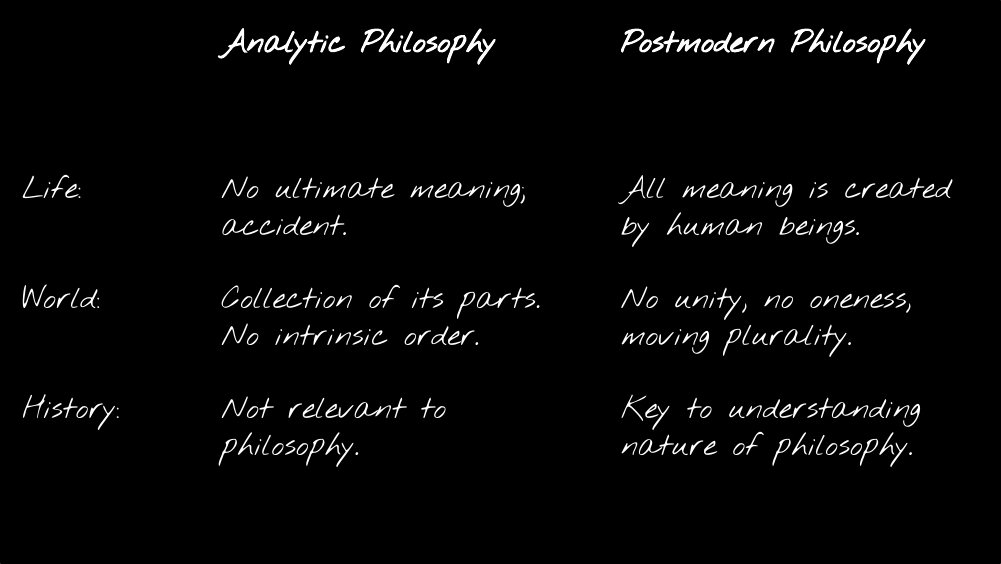
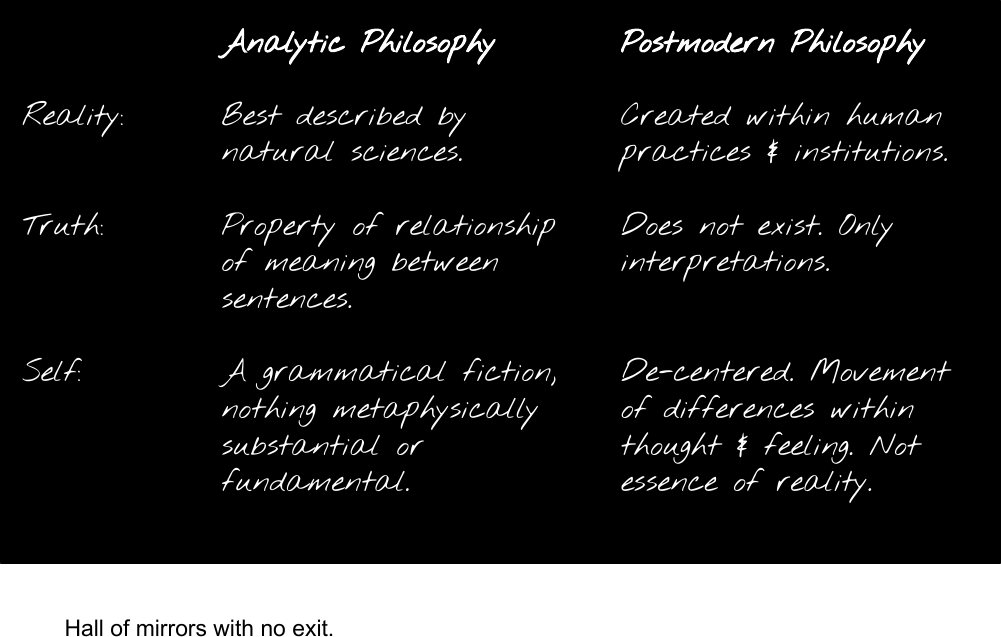
So this little attempt at trying to explain something that’s very important to the work of Wilber, I put before you. And before I go further, just a little deepening, which I find quite amusing: an overview of how analytical philosophy and postmodern philosophy contradict each other so beautifully without resolving anything. So I’ve got six phrases on the next slide: life, world, history, self, truth, reality. And we’ve got definitions, as it were, from an analytic and a postmodern way of looking at this.
So, for example, life, from an analytic philosophy perspective: there is no ultimate meaning, it’s an accident. From a postmodern perspective: all meaning is created by human beings. So we get into this - it’s either out there, or it’s in there, but we don’t get the reality of both equally. With the world: the world is a collection of its parts, has no intrinsic order; or, there’s no unity, there’s no oneness, it’s just a moving plurality, it’s like a fractal world without any prioritisation. History is not relevant to philosophy, say the analytical philosophers, whereas the postmodernists say it’s the key to understanding the nature of philosophy, because it’s all concept, it’s all humans.
Reality is best described by the natural sciences. When I was younger, I totally agreed with that, and the more I agreed with that, the greater the vacuum in me also became. And the postmodernists say that reality is created within human practices and institutions. I still cannot wrap my head around it, but that is indeed how they put it. Truth is the property of relationships of meaning between sentences - analytic philosophy is very wrapped up in language and the meaning of language - whereas postmodernists say that truth doesn’t exist, it’s only ever an interpretation. The self, just to really ram this home, is a grammatical fiction, nothing metaphysically substantial or fundamental. Wow. Postmodern philosophy says about the self that it’s decentred, it’s a movement of differences within thought and feeling, it’s not an essence.
It’s fascinating. When you see that our world is essentially stuck, whether it’s in politics, in business, or I’m just trying to arrange a family meeting over Christmas - these are the forces that guide decision-making, and we can’t make a decision because we can’t meet in the middle.
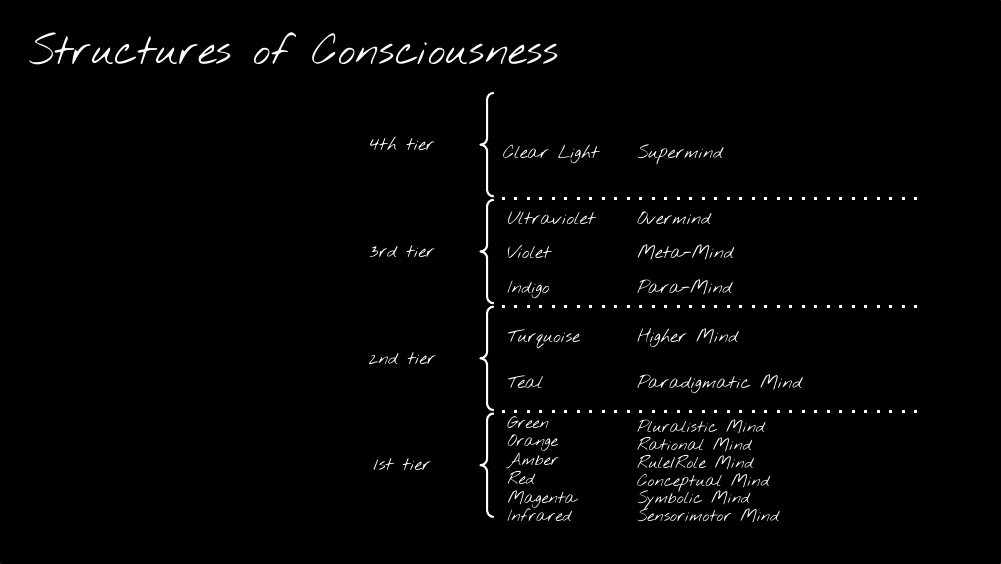
So now let’s do some real Wilberian work. I said earlier that Wilber sees there are three things that are important to consciousness: structures, states, and the unconscious, or the shadow work we need to do. Let’s talk about structures of consciousness. If we’ve done some work with Graves, with Spiral Dynamics, we already have a very strong sense of where this is going. But by way of some of the tidying-up work that Wilber has done - just to be really clear - he uses slightly different colours, and he adds a few colours to the development, because he’s decided to use the colour codes as they are in the rainbow, from infrared to ultraviolet, and then at the very top we have the clear light, when we have it all integrated. The reason he does that is because he says, whatever we imagine by way of symbols, even if it’s just light, we’re talking about energetics, and the energetic frequencies of it. They have a connection to layers of truth. It’s therefore important that we label things not quite so randomly, rather than introducing symbol systems that are related but different. It’s much better to work with something that has its origin in a natural frequency spread. So we have the rainbow, and we also often have, in the chakra system, for example - the chakras also follow the rainbow - so it’s not hard to see where he got this from.
He sometimes talks about eight levels, sixteen layers, thirteen layers. To a certain extent it doesn’t matter. But what really does matter is that where Graves leaves off above turquoise - he gives us coral, but he says nothing about it - Wilber takes it much further. In fact, what we’ve got here, I’ve put four tiers. Wilber prefers to speak of three tiers, but I’ve allowed myself to speak of four tiers, and I’ll tell you why in a little while.
We have down here the collection of the first tier: infrared, magenta, red, amber, orange, green. And I’ve put next to them the articulations for the different minds that are at work there, which are: the sensorimotor mind, right at the bottom; the symbolic mind; the conceptual mind; the rule, or role, mind, as in, we’re good at playing games and working with structures and hierarchical systems; the rational mind; and the pluralistic mind. The pluralistic mind is the green level, the pond or the soup of human knowledge that I just talked about. And we are sitting here trying to break through first tier into second tier. What we’re very good at, at the moment, is going back to red, amber, and orange in the process - in politics and everywhere else, really. We first have to fall apart in order to put ourselves back together again, I think, is the game.
Now, Wilber’s colour code then goes further. In second tier we have teal - that would be yellow in Graves’s model - and we then have turquoise for unity. It’s the same colour code for Wilber and for Graves. Teal is the paradigmatic mind, and turquoise is the higher mind in Wilber’s model. And now, for me, the real big thing that I’m trying to get across is this: when you go further up, it’s actually easier to see where you are now than it is when you’ve got this idea Graves gives us, that you can do an assessment and you end up with some colour, but you don’t really know what’s next beyond coral, or what even coral is. So there’s no sense of the coherence of the movement, and the beauty of Wilber’s model is that there is a real coherence to the progression through these colours.
We go from the paradigmatic mind to the higher mind, to what he calls the power mind, or indigo, in third tier; the meta-mind, or violet, next; followed by the overmind, or ultraviolet, when we’ve completed the rainbow. And the reason I’ve called the fourth tier here the fourth tier is because, for me, the clear light - which he calls supermind, using Sri Aurobindo’s classification - is like the completion of something. This is the highest evolution that, at least in the AQAL model, we can achieve, when all stages have been transcended and included. And by all, we’re talking about the evolution that wiped out the dinosaurs and created the mammals, and it goes back in this way all the way to the Big Bang. So this is an evolutionary model in which consciousness is like the fruit: it sits, and it develops this capacity to be all-enveloping, all-seeing.
There is only one thing that we have to discuss in order for you to make this happen in your own life. It’s possible, but you have to understand something, and it goes like this.
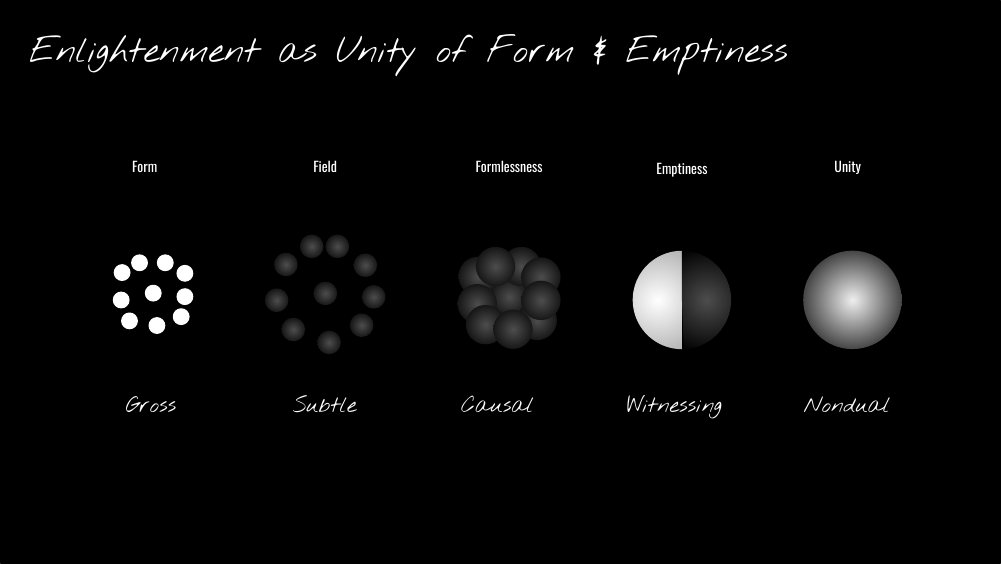
I already mentioned the existence of states of consciousness. States of consciousness, like being awake: we’re having a conversation, we’re moving in the so-called gross level of consciousness, where things mostly appear separate. It’s perfectly legitimate, it is one of the states of consciousness, and it’s not to be dismissed, as it often is - in consciousness circles people often talk about gross as gross. That’s not the case. It’s absolutely important.
The next level, subtle. In subtle we’re dreaming, for example, or we see the connections between things, we see that things are gravitational fields rather than distinct entities. Then comes a realm that is sometimes called the causal realm. The causal realm is the realm in which we are in touch with the elemental beings, or the mythopoetic matrix. This is where time is created, this is where space is created, this is where all the archetypes that you can think of are at home. These are basic units of the universe, whether in the material or the psychic; they are all the same thing. The point is that they originate some way, and then things are split through paradoxes, and then they become, like, space-time - the space-time paradox. These are the elemental things out of which everything subtle and everything gross is made. Very important: without going into it, this is where Wilber absorbs and integrates Whitehead.
The causal realm, in Wilber’s model - following higher schools of Buddhism, later schools of Buddhism rather than the early schools of Buddhism - the causal realm is a realm that is not fixed. The mythopoetic elements are not fixed. They change. They change because they have to, because that’s kind of how the universe works: it evolves, it is becoming. And in that sense we begin to understand that natural laws are not laws, but they are habits. The universe does this, and it’s evolved to do this, and what we call natural laws in physics is actually a natural habit. The reason that’s powerful is that that is the true source of evolutionary potential: a law can also start to change, and when there’s a change, it changes everywhere. It changes in the gross, it changes in the subtle, and it changes at the level of the elementary particles that make things up, which influences our internal and our external worlds. And that only has a resonance across all four quadrants if it’s happening everywhere at the same time. The difficulty is that we often are not trained or schooled to see it at those levels of subtlety.
As we go up this chain, from gross to subtle to causal, we move on into witnessing, sometimes called the empty witness. We are approaching the final level of paradox, or duality. This is where you’ve got so far that now, you’re still seeing the world, there’s still a subject and an object, but you’ve basically got to the stage where you’re realising that your temporal eye is actually being seen by an even higher eye, which is sometimes called the “I” - and that “I” is the eternal eye. The recognition that you have, when you’re in the witnessing state of consciousness, is the emptiness of all things, in the most positive sense. This is not terrible, this is beautiful, because this is the opposite of form. This is the deep time of Kairos, as opposed to Kronos, in the Greek tradition. But there is still the duality of the eternal eye and the temporal eye. You recognise that there is this everlasting flow, and that while you will go to sleep one day, you will also always be awake.
And that then is surpassed by the unity of emptiness and form, also known as non-dual, or unity consciousness. Sometimes it’s called the blue pancake, from the description of a Buddhist monk who realised one day that to be meant that he had no head, but instead of his head he could just take the blue sky and pop it on his shoulders. He had the blue-sky pancake, and that was, for him, a description of the unity of the world and himself, where no world and no eye ever existed as separate entities. He was the world, and the world was him.
So these states, they exist at all consciousness structure levels. From the first very basic development of the self - so, not at beige in Graves’s model, not at infrared in Wilber’s model, but the next one up - as soon as there’s an opposition between world and “I”, subject and object, we are experiencing the world through a consciousness state. And it might only be gross, but in principle, if we sit long enough, we will start to experience subtle, and causal, and witnessing, and non-dual.
I’m just going to flip back. No, I can flip forwards. In first tier, Wilber describes, you can have any state, and it’s going to be beautiful, but it’s going to have no effect. The consciousness structure and the consciousness state, they are independent. Really important: consciousness structure and consciousness state are independent. This is a little bit like, you take binoculars - this is your consciousness structure, through which you look at the world - and the state is what you see. But it has no real structural effect; it’s just nice. It’s profound, but it hasn’t got a structural quality to it.
However, as we go up this ladder, the states start to influence the structure, to the extent that you cannot get to supermind unless you have experienced non-dual ways of seeing the world. You cannot get to ultraviolet unless you have deep experience of the witnessing state of consciousness. You cannot get to violet unless you have a deep sense of the causal state of consciousness. And you cannot get to indigo unless you’ve got a very deep, internalised, embodied sense of what the subtle state of consciousness is. So, as we get to third tier, these consciousness structures are determined by our ability to access consciousness states. Does this make sense to everybody? So this is a little bit, in a very crude way, trying to explain how the rope of consciousness braids itself out of states and structures.
I’m noticing the time, and that I’ve gone a lot longer than I thought I would, and I invite you to make a decision with me, because I could go five minutes longer and talk a little bit about spiritual intelligence, or we could just leave it here and take it from here another time.
Joshua Malkin: Let’s go.
Claudius van Wyk: Take another five.
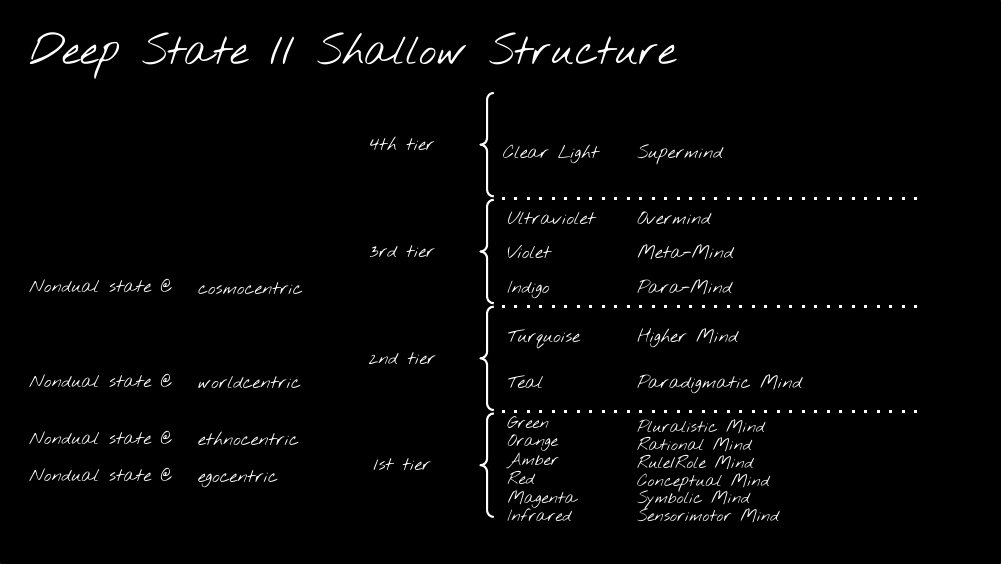
Marcus Link: Okay. I’m going to very briefly mention that I mentioned the phrase “deep state, shallow structure” earlier, and this explains how somebody can have a non-dual state as a great Zen master, and yet be misogynistic, racist, and so forth. The reason for that, in Wilber’s explanation, is that you can have a non-dual state experience at egocentric, ethnocentric, world-centric, and cosmocentric levels, and it’s your structure that will determine what it is that you see when you see what you see. If you don’t know this, you will think that you’ve achieved the highest level, and maybe you haven’t.
We talked earlier a little bit about absolute relativism. Now, absolute relativism points to the fact that this individual, or the group of people who believe in this kind of thing, actually have what Wilber would call spiritual intelligence, because spiritual intelligence, out of our eleven multiple intelligences, is the one intelligence that is concerned with absolute truth. It’s the only one of the eleven intelligences that deals with absolute truth. All the others deal in relative truth. So, in a way, you could say the definition of spirituality is our search for that which is eternal, for that which is outside of time, for that which is beyond all things. It’s very basic, but I think you will experience, as I say this, that it somehow resonates with you.
Especially when we have a very quick look here at what absolutism might mean at the different levels of the structure rungs. So, the one true way: blue religion. “I’m going to cut your head off because I love you so much.” This is the total paradox of the Crusades. Scientism: the belief in the absolute truth of the objective way of looking at the world. Or the green, postmodern view of absolute relativism. Then you get to yellow: everything fits in my model. Or, in turquoise: we are all one, you just need to raise your vibration, everything is a projection of consciousness. You might feel, at indigo, at violet, that only the sacred inner vision is real - and you totally forget to make your toast in the morning, and you go hungry. There are no absolutes, including this one, as we get to ultraviolet. And the difference between ultraviolet and green is that, instead of this being an epistemological utterance, this is a deeply knowing one, of being. We suddenly know that only this moment, right here and now, matters.
So, intelligences - keyword. There are eleven. I don’t know, there might be thirteen, but in Wilber’s model there are eleven multiple intelligences. In a very quick way of putting this, they are all organised as an array around the self at the centre, and I’ve tried to display that here by - oops, apologies - by putting the self at the centre of this cloud of dots. And there’s another dot close to the self, which is the spiritual intelligence. The reason I’ve put it close there is because they both have a role in determining our overall height of development. The self is like the average of our frequency modulator: all the intelligences are at slightly different heights, because of all sorts of different reasons, and the self is going to be the average of all of these. In Wilber’s mind, the one that does determine, that actually leads all the others, is the spiritual intelligence, because it has this seeking for the ultimate, which is how it gets to non-dualism at the end. It’s natural: sit for long enough, and you will have non-dual experiences. That is what it means to be human. We just don’t do it. But the fact that spirituality, and its spiritual intelligence, is so arrested in our culture is also the reason why the self doesn’t develop, or has a hard time developing further.
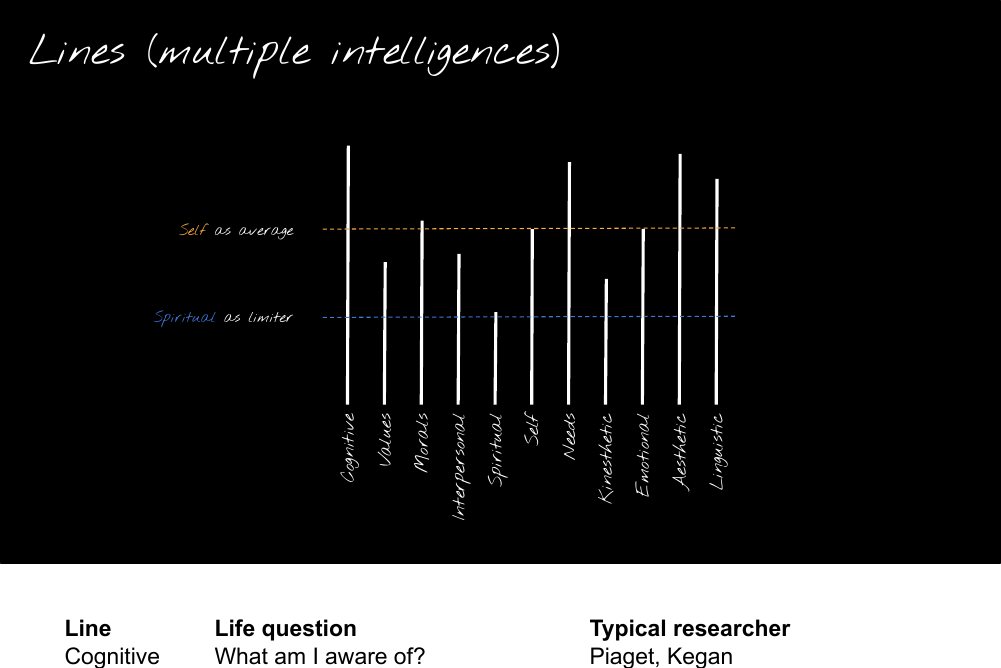
And I’ve just flipped that on its head, to get a slightly different view of the height of this. Wilber talks about altitude. The altitude can be at different levels for the different intelligences. They all strive towards higher levels out of themselves, and the environment around us, and how we engage with ourselves, determines how successful we are. The average of all of these is, if you want, the self - our own understanding of ourselves - and the spiritual intelligence is either the leader or the limiter, depending on how we look at it. And I’m going to leave it here now, as I’ve brought it to the conclusion of the role of spiritual intelligence in consciousness development, according to Ken Wilber.
Claudius van Wyk: Well, thank you.
Marcus Link: I just want to thank everybody for bearing with this avalanche and waterfall of words.
Claudius van Wyk: It’s a tour de force.
Joshua Malkin: It is.
Claudius van Wyk: And my response is one of deep gratitude, for not only the way you’ve articulated that, but for the work that you’ve done in order to be able to articulate it and show it. So my sense now is just to invite whoever, just to share the experience of listening to this, before we do any analysis of what we do with it. What was it like to listen to this? And just go. Don’t rush.
Joshua Malkin: Thank you, Marcus. If I could say, I totally agree with Claudius. It is a tour de force, and I think it’s a major contribution, and we are privileged to have it within the Holos group. I’m sure you’ll take it in your own way further. But for me the experience was like a pilgrimage, and coming to the top of a mountain and seeing the view. So thank you so much for that. I can’t digest it all now, but there are things within it, which you said, which resonate in a way which made me feel, this is true. So thank you. And I’m looking forward to hearing more, and digesting it more, and hearing more dialogue about what you’ve put together.
Marcus Link: Thank you.
EarthWays: Perhaps I’ll share some toast, because I’ll have to leave in fifteen minutes for another Zoom. Well, it’s not so easy to comment, but what you said - it’s a completely different level, but what you said is a little, how to say. I always had a bit of resistance towards Ken Wilber. I went to the integrative conference in, I think, 2018 or something, in Budapest, the big thing there, and somehow, yeah, I never liked him. Okay, that’s very simplistic, but I think there is something. And now I understand, from also what you say, that I’m deeply influenced from my youth, and growing up, and studies of postmodernism. Even in my time, I think we read Camus and the French existentialists.
Marcus Link: Foucault and Sartre, and so forth.
EarthWays: Sartre, Sartre, and de Beauvoir. They were our heroes when I was an adolescent. Being Belgian, of course, French philosophy always has had quite a big influence, and then, of course, postmodernism, the green era, all of that. That’s one side. And then I see that that is not so easy to take a distance from, because it’s kind of in your system somewhere. And the other part is my connection with shamanism, and indigenous cultures, where I still always have a hesitance about evolutionary systems, because I kind of always feel it’s a Western way of looking at the world. I think the nature way is a circular way, it’s not necessarily a spiral way, it doesn’t necessarily go up. And also, I think, in an indigenous way, or a shamanic way, the consciousness has always been there. The wholeness, the idea of wholeness, has always been there. That’s the basis of everything, of the whole way of being, doing, knowing. Bear with me, I want to show something from mine - you might know this.
Claudius van Wyk: Wow.
EarthWays: Sweet grass. Braided sweet grass. So it made me think, when you were showing the rope with the tree. This is also something that a shaman from Greenland, in his storytelling, said about all those strands: they’re very fragile, but woven together it’s extremely strong. I think that’s also that idea, that wholeness is in the culture, in the practice, in all those elements, I think, in indigenous cultures. So I’m still hesitant about the rising up to the highest point. And it’s perhaps because I’m myself a person of practice, of being in the world. My spirituality is not sitting or meditating - I’m not a meditator - but healing work, and being in the world, and helping people. Sometimes I think, like, I’m not spiritual enough, I should go on a twelve-day, ten-day silence retreat or something. What I have done is a vision quest, but that’s very different: you sit in nature, and you are in the whole, well, and you’re very frustrated at times. But, yeah, I don’t know. That’s a little bit - I cannot be more coherent, but those are things that go on for me.
What I really liked, I think, is this thing about the consciousness states and the consciousness structures, and how they’re independent. That I could really see, feel. And also the states - I think that’s definitely an added value for me, in addition to the structural side that we all know. Anyway, that’s a little bit, yeah, things that came up. The whole way to get to the talks you’re going to give, it’s going to be extremely interesting. Sometimes I think, oh, yeah, perhaps - oh, I love to hear you talking, because I like your language - and so sometimes I think, oh, it’s very complex, but I think it’s okay, because it’s like going in and out and dancing with it. And also we have, I think, three sessions there, so you have the way - I don’t know how you’re going to structure this, but that’s perhaps for later, to help you a bit, for the design of the talk.
Marcus Link: Well, I want to comfort you. Firstly, thank you, and secondly, really celebrate the fact that your response is, in my view, precisely right. But I’d offer you in return that I think Wilber can be really wrong about something and really right about something else. This is the very fine line that I’m trying to walk. I want to leave you with the following symbol, rather than metaphor, which is that my whole thinking has gone towards: okay, we’ve got Wilber, he’s really strong about hierarchies and evolution in a certain way, and he almost contradicts himself at the end, where everything then, somehow - it’s not like it reaches a sort of final destination, it’s almost like it tips back in on itself, which is circular, just as you said. And I got this feeling that he thinks he’s right in the centre of something, when actually he’s really away from the centre. He’s so structured, he’s so analytical, he’s so highly intelligent, so masculine - there’s something missing. But that which he does is really deep, really differentiated. So there’s this strange thing going on, and what I’ve been looking at is, what’s the blindness? Where is the rest? How do we square the circle, so to speak? That’s really where this whole thing goes. I don’t want to say too much now, not least because maybe other people want to say something too, but I just want to celebrate you for picking up on that. It’s precisely indigenous wisdom that, for me, is one of the major sticking points in this. It sits somewhere else than Wilber says it is. Thank you.
Claudius van Wyk: Thank you for that exchange. Thank you.
EarthWays: I will disappear when I have to disappear. So, anyway, thank you very much, and see you soon. But I’ll stay for a few more minutes now.
Marcus Link: Thank you, Chris.
Claudius van Wyk: Hey, Chris.
Ken Obiakor: Thank you. And I share with Joshua - there’s a lot of things said here, so much detail. I know what detail does to the brain. So, yeah, thank you, Marcus. And thank you, Claudius, for inviting me. My question, like you said: the truth is a resonance. While we were speaking, I was thinking, why do we grow in consciousness? Why is it that sometimes we dance to your music, and sometimes we don’t dance? Is it that the music cannot be danced to? This is a way we bring - how we are resonating with the truth out there. The more we bring consciousness, the more music we can dance to. It’s not something that I intelligently know, but it’s something that is just like a little boy who stood in the class, and the teacher was asking, “Hey, John, who whistled?” He said, “I did not whistle, the whistling whistled itself.” There is something my body knows, that once I see it, once I hear it, my body identifies with it. So, that truth resonates, it’s out there, we are - and therefore, it unfolds through us. And it cannot really be structural, because when you structure it, you linearise it. The intelligence, or the clarity, that a structure can supply to you can take you away from the parts, from keeping going, from the process.
So I wrote down a lot of things, which I’m going to - because right now, for some time I’ve been looking for a shaman in my culture, and I think I have found one. I’ve been having serious and mind-shifting conversations with him. I think it was Meister Eckhart who said that intelligences might argue, but at the mystical level the language is the same. And as I’m listening to you, I reconcile a lot of the conversation I’m having with the shaman. I’m going to do a writing with this, and probably share it with the group, like a reconciliation. When you speak, I see - I don’t want to use the word “linear”, but I see. And it always reminds me of the word for love in my language, which is “seen”. It is seen. Everything that is happening is seen, like the rays of the sun allow us to make sense of the sun. Everything is enabling seeing. There’s nothing standing in isolation. The seeing is what we are observing; the thing, or seeing itself, is what we are observing.
So I would like to share with you, Marcus, some things that I find very, very resonant. You spoke about religion as reduced to statistics. That is very, very important - when it’s reduced to statistics, and the fragmentation takes over. We spoke about the subject not being contained in the subject. I find that very, very interesting: the subject is not contained in the subject. When you speak about Ken Wilber’s three stages, and then the fourth stage that you added - Claudius, you should remember, sometime I was telling you about the fourth dimension. So the shaman was telling me of a fourth dimension, a fifth dimension, and then a seventh dimension. He is trying to tell me that when we get to the seventh dimension, the consciousness rests - it achieves a form of stability, that it is no more something that leaves us and comes back. It’s a kind of rest. And you can now actually function with it, you can actually work with it.
So he asked me to try out something. He asked me to get a - I hope I’m not taking so much time, please - he asked me to get a pot, what we call a pot. This pot, I used to observe it when I was younger. We put water into it, and if you leave it for a while, the pot kind of makes the water become alkaline and natural, making it more drinkable. So he asked me to get the pot, get other elements - I have not located their English name - and then the space, the four walls, the three-dimensional space that the pot allows me, allows me to clone intention. I can clone intention within that three-dimensional space. This is crazy. I tried it. I’ve never wanted to continue, because I don’t really know where I’m getting to, I don’t want to do something dangerous. What the four walls allow us to do is to clone intention. And he is trying to say that one of the challenges is that there is a fragmentation between the spiritual and the human. There is a fragmentation between the human - as Ken, as Marcus, as Claudius - and then the human as spiritual. He said that both the human as physically evident, and the human as spiritual, they are both physical. They are both physical reality. It’s not something that is differentiated.
So, without - let me not take so much time - I wrote down a lot of points which reconcile, which make me understand better the conversation I’m having with the shaman. So I’m going to bring these two conversations together, reconcile it in a way that allows us to look at it and probably see. It’s so mind-boggling. So I’m very, very happy that I was able to be invited today. Claudius, I thank you for reminding me, because I forgot - I forgot that I’m supposed to be - I’m consumed with something. When you talk about the universe individuating, and the individual universalising, you begin to see that there is no difference, there’s no separation between the physical and the spiritual. The only difference is intentional density. The only differentiation between the physical and the spiritual is just the density of the intention. And so it is intentionality. It is intentionality that reconciles the whole. It is what makes someone that used to be materially minded become spiritually minded. It’s just intentionality. It cannot be structured. We cannot think ourselves into consciousness - it is not possible. We can only intend. The shaman told me about the yam tendrils. When you plant a yam, you just need to give it something to climb. There is an intention there, an intention that cannot be separated from the energetic field, or the way we are working with energy. Thank you so much. If you leave me, I’ll continue this discussion. So I’m going to reconcile this with what I’m already writing on. What someone is saying is so deep, Marcus. I remember, sometime you wanted me to help you with this, but I think I’ve got something to share with you, especially with the enlightenment he just made possible. So thank you.
Marcus Link: I’m so pleased, Ken. Thank you for this beautiful reflection. I’m really honoured. Thank you.
Ken Obiakor: All right.
Claudius van Wyk: Wonderful. Would you like Kenneth’s notes? Would you share your notes with Marcus, Kenneth?
Ken Obiakor: Yeah, sure, I would.
Claudius van Wyk: Excellent.
Claudius van Wyk: So, very briefly, from my side: there were seven points to which I responded, and I’m just going to give the first and the last. The first was related to a conversation that I’ve been having on LinkedIn, where one of the people, who’s in communication education, has said all knowledge is phenomena. I was looking at phenomenology. I went back to Kierkegaard, Gadamer, for sure. And in looking at Kierkegaard, I went back to my studies in philosophy, where my professor said that for Kierkegaard the deep state of intersubjectivity was the leap of faith to God. From Kierkegaard’s perspective, each state of intersubjectivity was the leap of faith to God. So when you were talking about the third space where you started, my mind was looking at that third space, and the deep divine in which we move and have our being. It gives a nice way of being able to apprehend and comprehend.
And the last point - and I’ll send you my notes as well, if you’d like them - relates to the question of absolute truth. Pontius Pilate says to Jesus, he says, “Quid est veritas?” And Jesus says, you’re looking at it, I am that. And then Pilate makes this funny statement to the audience. He says, “Ecce homo”, behold a man - that we’ve beaten up, this broken physical [unclear]. He doesn’t get it. Those questions, he just doesn’t get it. And that came to me as a complete integrative frame. I’ll share my other points on what you were sharing.
So the point that I think I’m left with is that, from a sharing through the Holos network, we can be discerning about how we put the invitation, but the invitation does offer the opportunity for opening a window, that takes the notion of spirituality - the way you were expressing it so passionately, Kenneth - from being a woo-woo concept, your postmodernism and the analytical and all of that, to: it is reality, as you wish, every day. We can open a window in our own conceptualisation, and with a window open conceptually, we might be able to give ourselves permission to experience something else in our daily life, as Chris was trying to share. So I’m very grateful, and I’m very excited about how we can put this out into the world. My sense is that it’s more than three. My sense is -
Ken Obiakor: You really want to chunk it down. Yeah.
Marcus Link: Yeah, I could probably have left out the bit about how I got here and just gone straight to Wilber, but it was important to me to reflect on the biographical journey, because in a way, that’s the spirit in action.
Claudius van Wyk: Well, I think this is so important. I think it’s so important, your journey - as you express your journey and your qualifications, it creates the space where people can sort of take it or leave it. They can see that this is you working with it, what you resonate with, what you find problematical. I think your experience is not just sharing intellectually; it’s your experience that I think wants to be shared.
Claudius van Wyk: Yeah, Michelle, I’m just going to switch off my mute.
Michelle: Okay, is that okay? Sure. So I want to comment on something you were saying, Claudius, and I have just lost it. Okay. I think in future I must always go first, after all these really very powerful comments. So firstly, Marcus, I really always love listening to you. I love your voice, your eloquence, the storytelling, the poetic kind of words that you use. So you are always really engaging. Thank you. I find, though, that my journey - maybe picking up on Joshua’s metaphor of the pilgrimage - I feel I’ve been told about the pilgrimage now, and now I need to go and walk it. And it’s like, wow, what is all this richness that you’ve shared with us?
Maybe just a few points that I was thinking of. They’re not very well structured, just as they came up. When you were talking about your like and dislike for some of the things that Ken Wilber talks about, and how he’s so rigid on his structure, and yet at the end he seems to almost fold back in on it - as you were talking about that, I was thinking about how we’ve been listening recently to Iain McGilchrist, and exploring the understanding of the right and left brain, and the functioning of the union of the right and left brain, and the most important work each function does. I got almost the sense of: did Ken Wilber sometimes get fixed into his left-brain hemisphere, where he was doing deep analytical ritual, and then he would hop back into his deeper essence of himself, into the right, where he was seeing the big picture, the big philosophy? But then he got trapped in our mechanistic, scientific, materialistic worldview, that there’s structure and form and shape, and science is the way to go. So he’s writing this book, and he has to be the one who knows, therefore he slipped back into this left hemisphere to write the book, where he needed to give you all these structures, and that kind of thing. And all those structures are so helpful as a reflection. It helps me think. I can have these models and these ideas, because it can help me recognise what I’m experiencing when I go into the right hemisphere. So that’s what I was kind of thinking about as you were giving us the story.
Then I thought about the idea of these deep indigenous cultures, and the power that they have. And even the power of “kin” - how many times you’ve explained the word to us, love, and I’m always transfixed every time you say it. I listen as if I’m hearing it for the first time. I think it would maybe be really important to think about how to prevent - like what happened now with Chrissy, she’s spoken about this before, that she doesn’t like these hierarchies. I think it is something - I’m not sure, I was trying to work it out as I was listening to her, because she was absolutely valid and totally invalid for me, listening to what she was saying. But I was thinking, is it because she’s talking about it from a certain worldview that makes her see evolution as a hierarchy, and not evolution as an expansion? And I thought, is it the worldview? But I’m not sure. And so I was thinking, in your explanation - because it will be very much a green worldview that will be attracted to listening about consciousness, but they may stop engaging when they come up with that barrier of hierarchy. And so it was like, hmm, how to phrase it in such a way that doesn’t trigger that. Like, when you say to people “church” - there are many people who, you just say “church”, or you say “the Bible”, and they stop listening. And it’s so sad, because that’s not actually what we’re talking about. We’re not talking about their model of church or Bible. So I thought, I don’t want you to lose your audience by that response.
And then the last thing was, in the very beginning, you were talking about Graves, your disappointment with Graves, that he couldn’t describe coral. And I was thinking back to the stories that Christopher would tell us - and I want to get this from him, and maybe you have it - he puts the evolution of the different value systems into the actual times that they evolved, in the years. And I was thinking, did Graves not describe coral just because coral can’t be described, because it hasn’t evolved yet? It’s not here yet. And if he described it, he would be making it up from his current consciousness, which isn’t the evolved consciousness. So we can’t know what those other structures are, and they’re not six or eight or ten or twelve. In humanity, in our evolution of humanity, there may be hundreds. And so I was just thinking: do we not know what coral is? And is Wilber telling us about those higher levels from a deep, deep super-consciousness of where he went to in his experiences, and described them? Or is he calculating them from the data that he’s got?
Marcus Link: Thank you, Michelle, brilliant. I’m really glad that what I put out there is having these resonances, because what you’re giving back to me is exactly what I went through - through what Chris contributed, through what Kenneth is contributing, through what you’re contributing, what Claudius said. I’ve had all of those in my own way, you know, but there’s an overlap that’s significant in terms of my life experience: of shamanism, of indigenous people, of the left and right hemisphere. And I have an answer to all of it - not because I think I’m right, but because I’ve played with it for so long that something emerged that I’m feeling so excited about, that I just want to share it with other people. And this is where this is going. And I actually wanted to give a preview. If you have two minutes, I can just do that very briefly, because I hear you, Michelle, and I wonder whether I should give a preview first, in order to say what’s coming, so that people don’t run away from things that they react to, so that they know, okay, this is the beginning, and this is where we’re going.
Michelle: But the preview is great. And the other thing that I was wanting to say, that I missed - sorry, it wasn’t the last thing - when I said earlier something that I want to make comments about, when you were talking about your personal journey, and you say maybe you shouldn’t have told it: I very much think you do need to tell it. But I’ve listened to many podcasts lately, and I’ve gone there because of what they tell me is going to be shared, the title, and so when the presenter takes the first five minutes telling me about themselves, I kind of lose interest. But I love it when the presenter tells me about themselves when they weave it into the story. Like, I was so excited when I picked up Wilber, because I had had this challenge when I was a child, but when I was reading Wilber I struggled with this and this. Because you tell - you weave it in that way, then I really want to know your story, because now it’s giving more impetus to the content you are telling me about Wilber, how he structures things, or whatever. But that’s just one person’s survey of one - that’s my experience, when people take too long to introduce themselves.
Marcus Link: Well, I get it. I like the connection to the purpose. We’re talking about something that has deep meaning in my life - that’s the whole reason I’m speaking to you about it, and this is why. And so, I could do it shorter, but -
Michelle: I’m not unhappy, right.
Marcus Link: Okay. Yeah. Ken.
Ken Obiakor: And then, something which helped me to remember - because we are talking about this point of observation, the point we are having the experience with. The shaman was telling me that we don’t know, no matter how much we think we have it. This is my point: I am holding it, I know the colour, I understand it - you don’t know it until it is unconscious. Until you throw it out there, until you speak it to Mitya. It is Mitya’s light that will let you see it.
Marcus Link: Yeah, yeah.
Ken Obiakor: He is saying that, according to him, the thought is the second stage of reality. So that brings you perpetually into relations, that makes you understand you are a relational being. You can never stay away from that relationship. And it reminds me, Claudius, of the whole thing about holism: to enable the seeing. It’s all about enabling the seeing. It is a seeing that constructs us. It is what realises us. So it’s all about participating. Like I’ve always said, to participate comes from the consciousness that you are a part. You are a part of it, so participate in it, and enable the seeing to happen. That’s love.
Marcus Link: Beautiful, beautiful. So, do I take two minutes to just tell you where it’s going, or do I leave it to the next time? Okay, I’ll do it.
Ken Obiakor: That’s not much time.
Marcus Link: So, what I came up with - which is why I talked about Schumacher’s philosophical maps - is what I call the Compass Rose of Consciousness. So it’s a compass, and it tells you about the direction of consciousness. At the centre it has unity, and the further away you get from the centre, the more you get into the rigidity of extreme perspectives, until you fall off the edge of the flat world. This insight actually came to me through listening really intently to Wilber, because he intends to talk about wholeness, but actually - as you pointed to, the left hemisphere - I think there is some right hemisphere at work in Wilber, but what he does is he gives it a very low priority. What he gives a very high priority is structure. And so Wilber is actually on the movement to fall off the plate at the far end of his flat universe that he’s created, while at the same time he’s talking about wholeness and structure in the most beautifully differentiated view. So you see, this is the problem with wholeness: we have to find the proportionality. Everything is true, but we have to find the proportionality of its contribution, and what goes wrong with Wilber is that he gets lost in structuralism.
So the map that I came up with - I was looking for the opposite to hierarchy, which is what he talks about, his hierarchy. It’s the transcend-and-include hierarchy. When you look at a tree, a tree is hierarchical: it has roots, it has a stem, it has branches, it has leaves, and it’s a system that is hierarchical. It has a priority in its development and its functioning. When you look at the rhizome, the mycelium underground, it’s a totally different system. It’s fractal, it’s not hierarchical. It’s rhizomatic consciousness, I call it, or fractal consciousness, which means that it can appear out of nowhere. It’s part of the field, part of the matrix of ecology. But without the mycelium, you don’t get any trees. So you have a relationship between the fractal, or rhizomatic, consciousness of things, and hierarchical consciousness. They are both really important. They are like two halves to something whole.
And now, here’s another thing. You mentioned it: left and right hemisphere. Brain structure determines world structure. You have to have, in a map of consciousness, the structure that is being conscious, otherwise it’s not really consciousness. So if you now imagine a compass, north-south, we’ve got holarchy in the north, and we’ve got rhizomatic consciousness in the deep south. And now we’ve got the east-west axis, which spans left hemisphere to right hemisphere of our brain, with the integration point at the centre. So the synthesis happens in the middle of all of these consciousness forms.
Now, just to complete this picture: I’ve not left it at hierarchical consciousness and rhizomatic consciousness, because that felt too structured for me. So I went to the one philosopher that I’ve always admired, and only now fully understood, which is Friedrich Nietzsche. Friedrich Nietzsche is like a sore thumb in the European philosophical tradition. He went mad - this is how intense this was for him. All of his books are slightly different: that one’s over here, one’s over there, one’s over here. What he did, in his first major work, is he looked at Greek tragedy and its role in the development of literature in the West, and he looked in particular at the two gods, Apollo and Dionysus, and how they were opposing each other. They both like food, but the one goes to excess, and he knows no limits, and he is totally engaged in the excess and abundance of life. It is what, in the Western tradition, we often think is bad. Apollo is structured and disciplined, and he brings about agriculture under difficult circumstances, and it can be very life-giving. But when you bring in too much structure, it also dies. If you bring in too much Dionysus, it dies.
Good and bad have a very interesting phenomenon. Unconscious goodness is bad. Unconscious badness is very bad. But conscious badness - so allow me the play of words here - conscious badness is very good. But in our culture, Western culture, the Dionysian, the rhizomatic, the weeds that grow in your garden, they are bad - but they are essential for life. So what I wanted to create was a consciousness that is true to life, at the centre of which sits life. And so I took the guy who went mad, and I used what he was trying to talk about, which is: he says we are in danger, Apollo is crushing us under his thumb, we need Dionysus. And then he came up with this thing he called the Übermensch, or Superman, which is kind of very green - but it was like he was going to thump him one. The problem with his Übermensch is that he goes to an extreme which is also not survivable. It doesn’t hit the centre. But I made sense of it, because it’s the extreme reaction to an extreme evolution.
So if you look at it on my Compass Rose: Wilber sits in the north-west - left hemisphere, Apollonian. It’s very structured, but it’s very powerful as well. If you look at somebody like Jan Smuts, or Iain McGilchrist, they sit over in the Apollonian, because they are structured, but they sit on the right hemisphere. Does that make sense? So you’ve now got Wilber as the opposite to Jan Smuts, for example. And then you can move them up and down, you can have a look, but every single language you can position on this compass, every single book that’s ever been written you can position on this compass, every philosopher, every religion you can position on this compass, including indigenous religions. They sit in the south-east. Indigenous religions, they come from the Dionysian realm, and they are very right hemisphere. They are very anchored in a holistic wholeness view. You could say they lack structure, and that sometimes we need more structure. You can make these criticisms. But what’s important is that there’s an edge to survivability. When your consciousness moves beyond that edge, it’s not survivable. Then you get climate change, then you get the sixth extinction event, you get failing economies, you get Trump, you get all sorts of things that happen, because the consciousness is too structured or not structured enough.
And this is the Compass Rose, where it’s going. It’s using the directions in order to position all sorts of things, and every time I position something on it, it’s like the lights go on, because I recognise, oh, this is how it works. And for me, that’s just like a beautiful insight: that sometimes the completion for wholeness is in the realm of the evil. You have to find - as in the traditional idea of evil - you have to resolve the wholeness of it by bringing it together, in order to find the life-giving space. And that’s where this is going. So I’m going to go to McGilchrist, I’m going to go to indigenous traditions, and I’m gradually going to build this Compass Rose, and then, in the third session, it’s all about that. And now I have to leave, because I’m late to make food. It’s my job to cook, and I should have started half an hour ago.
Joshua Malkin: Wow. Fine.
Claudius van Wyk: Three more minutes.
Marcus Link: Three more minutes.
Claudius van Wyk: One part of me is saying, this is so rich, it needs so much further curation. And another part of me is saying -
Marcus Link: Okay.
Claudius van Wyk: Let’s fix it, that, and, Marcus, straight into the pool and get on with it.
Marcus Link: I’ve got a life to live as well. So let’s take it in small stages. But thank you, thank you for the enthusiasm.
Joshua Malkin: Thank you.
Claudius van Wyk: We’re going to let you go, Marcus. Thank you so much.
Marcus Link: Thank you. Thank you so much. It’s been a real privilege, and it’s really helped me very much.
Claudius van Wyk: Wonderful.
Ken Obiakor: Okay, Marcus.
Questions & answers
What does Ken Wilber mean by waking up, growing up and cleaning up?
These are three dimensions of spiritual development that Wilber says we usually run together. Waking up is about states of consciousness, the gradient that runs from gross through subtle and causal to witnessing and non-dual. Growing up is about developmental structures, the stages Spiral Dynamics describes. Cleaning up is shadow work, the confrontation with the unconscious, and his point is that all three have to travel together.
Why does Wilber say the states and structures of consciousness are independent?
Because you can reach a very deep state and still sit on a shallow structure. Someone can taste non-dual, unity consciousness as a seasoned meditator and remain egocentric, even a racist or a misogynist, if the developmental structure has not grown with it. Wilber cites a colleague, a psychology professor who is also a Zen master, who found that something like eighty per cent of the obstacles in his students' meditation were really undone shadow work. I picture the structure as the binoculars you look through and the state as what you happen to see.
What is the 'fourth turning' that Wilber says religions need?
It is a phrase he borrows from Buddhism, which counts three earlier turnings in its own history. Wilber's claim is that the faiths have been arrested in time, some for a century, some for the better part of a thousand years, and that they cannot keep repeating a dogma while human knowledge moves on around them. A fourth turning would integrate what we have since learned about growing up and cleaning up, not just waking up. He makes the appeal to every tradition, though Buddhism, his home for decades, is where he begins.
What does Wilber mean by truth as resonance?
He loosens truth from being only correspondence to the facts or coherence between statements. Truth, for Wilber, is a resonance you can feel across all four quadrants of experience at once: the I of your inner life, the it of the objective world, the we of culture and the its of systems. When something rings true across all four, your gut knows it, and when it rings false you feel the 'yuck' just as bodily. I found that a beautiful way to land truth, in the body and not only in the argument.
What first drew Marcus from Spiral Dynamics to Ken Wilber?
Working with Spiral Dynamics, I kept arriving at the top of Graves's model, where you reach turquoise, then coral is named, and after that there is only a question mark. I understood why: Graves worked strictly from evidence and would not speculate. But something in me wanted to know what happens to spirit as consciousness evolves, not as fantasy, as orientation. When I put that to Christopher Cook he thought for half a minute, told me to read The Religion of Tomorrow, and I devoured it.
What is the mythopoetic matrix?
It is the name I give to the foundational layer of archetypal energies that animates the psyche and the cosmos alike. By archetype I do not mean only the figures of myth; I mean space and time, the energy held in a quark, the pull that keeps an electron turning round its nucleus. It matters because the stories we live and the stories we tell rise from the same ground, replicating like Russian dolls across every scale. The inner world and the outer world are not two matrices but one, met at different depths.
Who is Marcus Demetrius Link?
I work where philosophy, depth psychology and ecology meet, and I gave these talks through the Holos Earth Project. I trained in philosophy, though I came to it first with a Continental, German-speaking love of the subject and only later met the analytical kind in Britain, which sent me looking for the wholeness it seemed to have mislaid. Jung has been a long companion, and I have been in Jungian analysis for nearly thirteen years. Much of my recent thinking, including these two sessions, feeds a book I am writing, 'Keystones in the Patterns of Place'.