The Role of Spirituality in the Evolution of Consciousness · Part 2
The Role of Spirituality in the Evolution of Consciousness – Part 2: On the Relationship Between Time, Meaning, Consciousness, and Human Agency
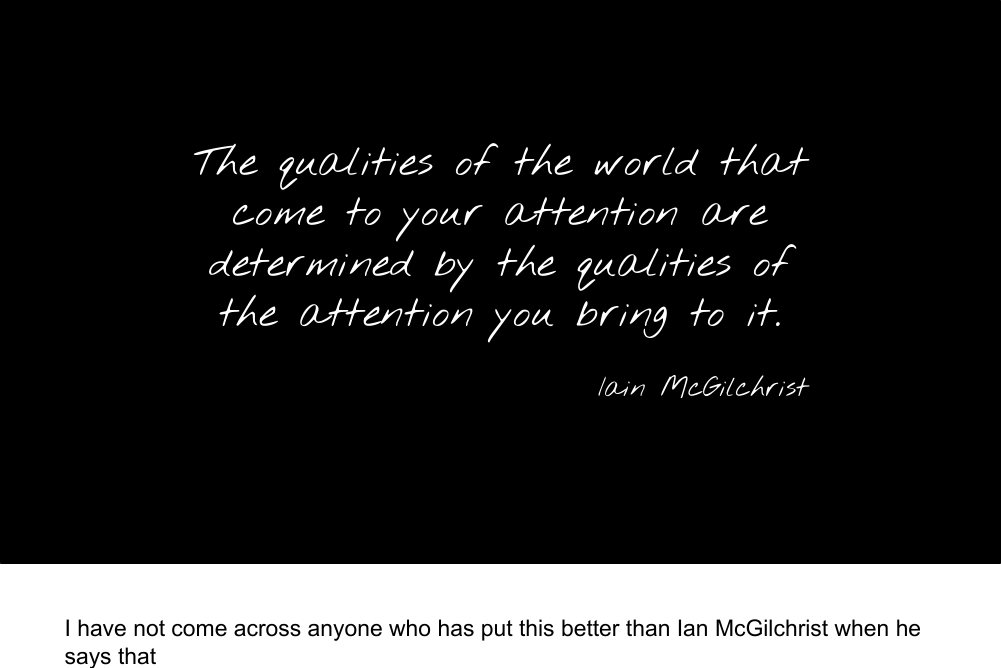
I gave this, the second of two linked sessions, through the Holos Earth Project while thinking aloud towards my book Keystones in the Patterns of Place and the talk I gave on 22 May 2026. It is working ground rather than finished architecture. Some of what I try here reached the book and the lecture, and some I tested, heard back on, and set aside. That testing is how the work finds its shape.
In brief
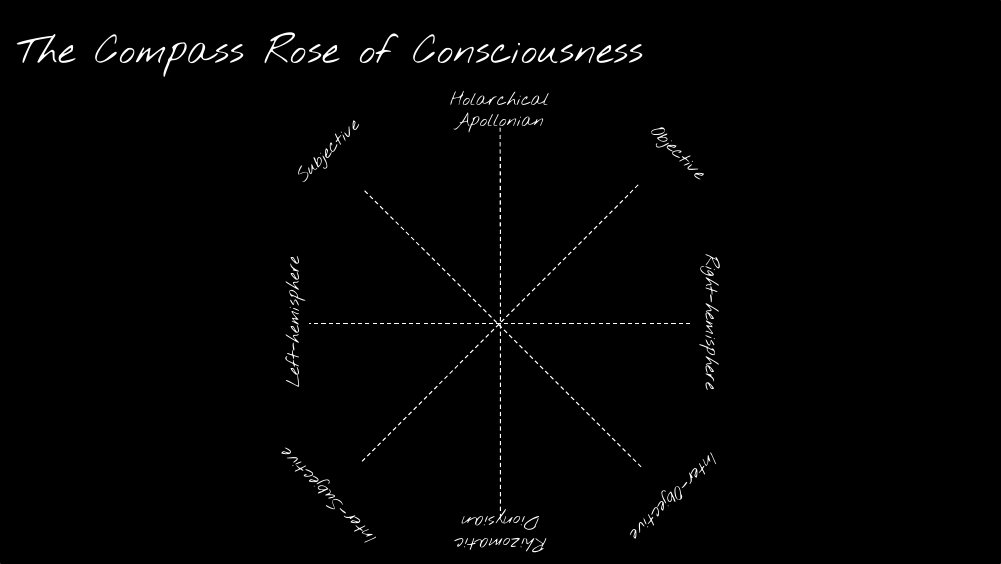
Why do some arguments refuse to stay practical and turn instead into questions of life and death? This session starts there, with spiritual intelligence and its taste for absolutes, and widens into time, meaning and agency: Weber's disenchantment, Goethe's lessons of three thousand years, Yunkaporta's remembering, and the two hemispheres of the brain. It closes on the Compass Rose of Consciousness, a way of orienting that is a field to stand in rather than a ladder to climb.
Slides

In depth
An argument between a vegan and a carnivore looks like a disagreement about food. It never stays there. It becomes an argument about life and death, purity and violence, until compromise feels like betrayal. This is spiritual intelligence at work. For Ken Wilber it is one of eleven intelligences, and the one that deals in absolutes while the rest stay relative. That is why such debates run hot.
His model is magnificent, and almost too perfect, a skeleton without flesh and blood. Criticise it and it tells you your criticism comes from a lower rung of the ladder. The thing is immune to the growth it preaches, and real growth asks for vulnerability, while the model has armoured itself against being wrong. So I began to ask what the ladder leaves out.
It leaves out the wisdom of indigenous cultures, which a hierarchy of ascent can only file as an earlier stage. When I listen to Tyson Yunkaporta I do not hear an earlier stage. I hear someone with access to something we have mislaid. The help we need from him, he says, is not to learn Aboriginal knowledge as content but to remember our own ancestral knowledge. Development stops looking like climbing higher and starts to look like remembering deeper.
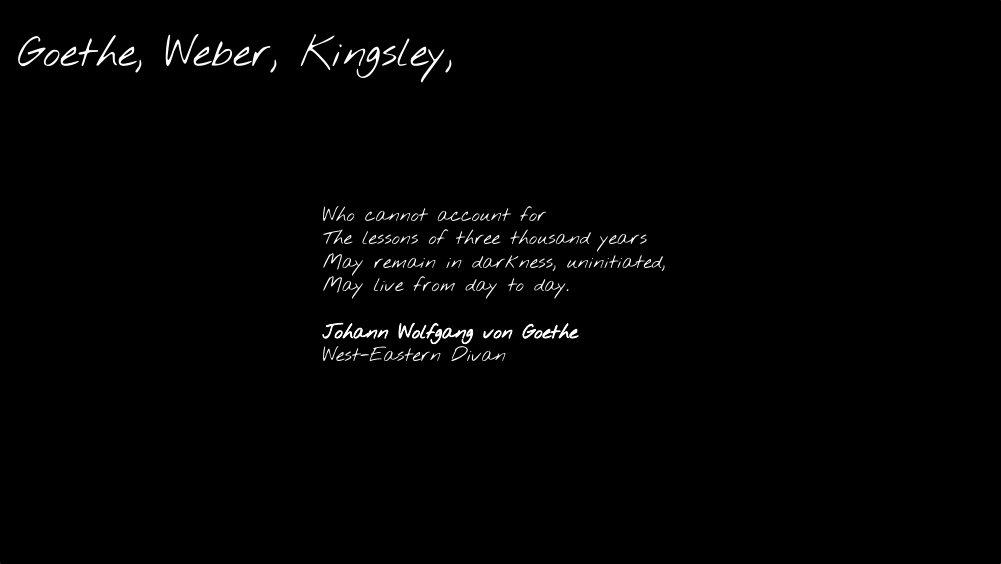
Then Goethe, in a line I translated myself from the West-Eastern Divan: who cannot account for the lessons of three thousand years may remain in darkness, uninitiated, and live from day to day. The initiation he means is into our own agency, and it turns on where we place ourselves in time. Without it we inhabit a flattened present with no past and no future. We can measure a forest’s biodiversity to the last species and still not halt its collapse. We have information, and no orientation.
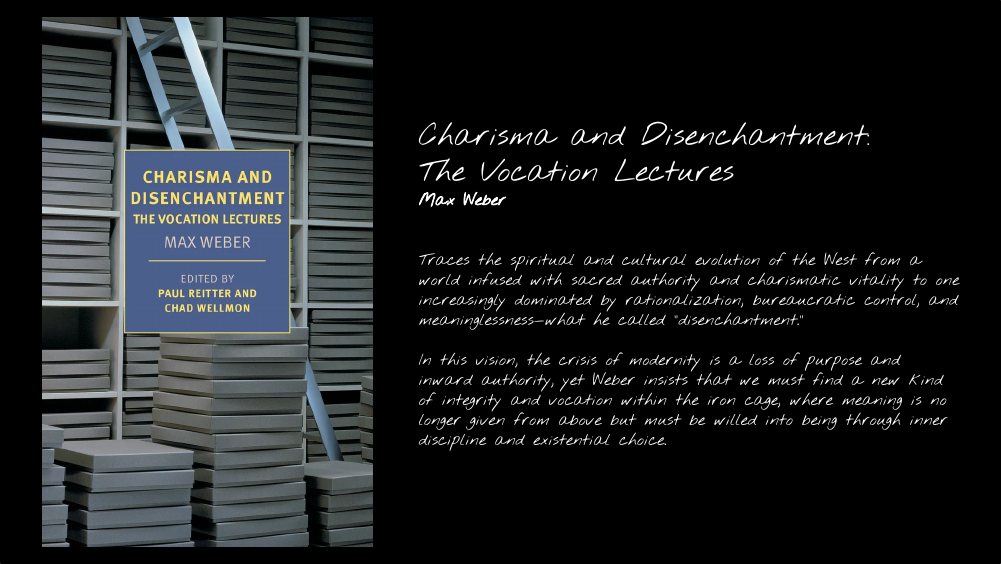
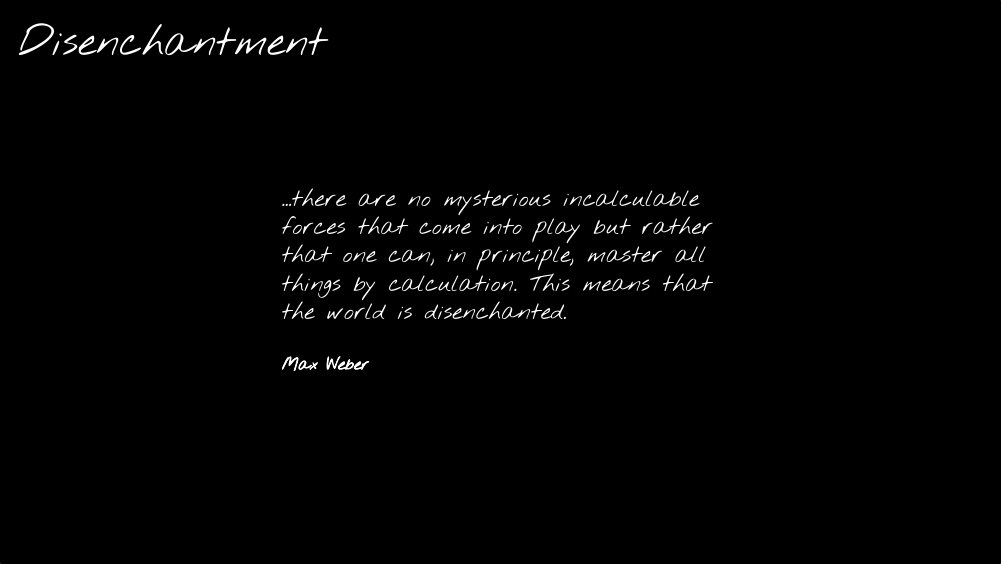
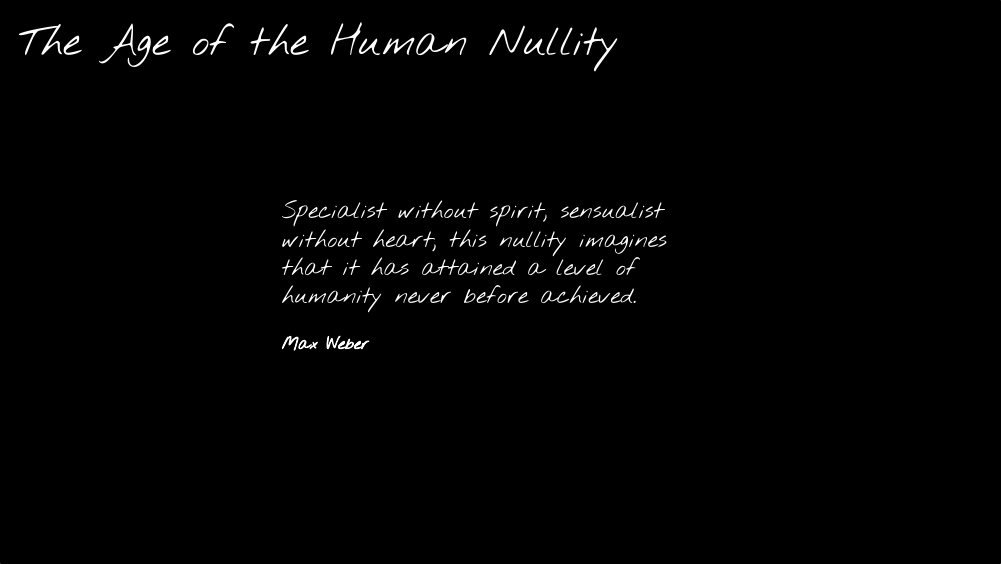
A handful of thinkers describe the same loss. Max Weber named it disenchantment, mystery traded for calculation, a promise of meaning that ends in nihilism, until we are locked in the iron cage of institutions that feed on our agency. His verdict still lands: specialists without spirit, sensualists without heart. Henri Corbin called the way out the north beyond the north, a vertical axis the old maps drew as spiritual cartography, reachable only through inner work and an imagination that perceives inner reality. We go inward in order to go upward. Peter Kingsley takes us further back, to the practice of incubation, a descent into the cave and the dark from which rationality flowered. We kept the flower and forgot the root. Iain McGilchrist retells it as neurology. The emissary, the grasping left hemisphere, has imprisoned its master, the right, and built a hall of mirrors, institutions, architecture and schooling that reflect its dominance back at us.
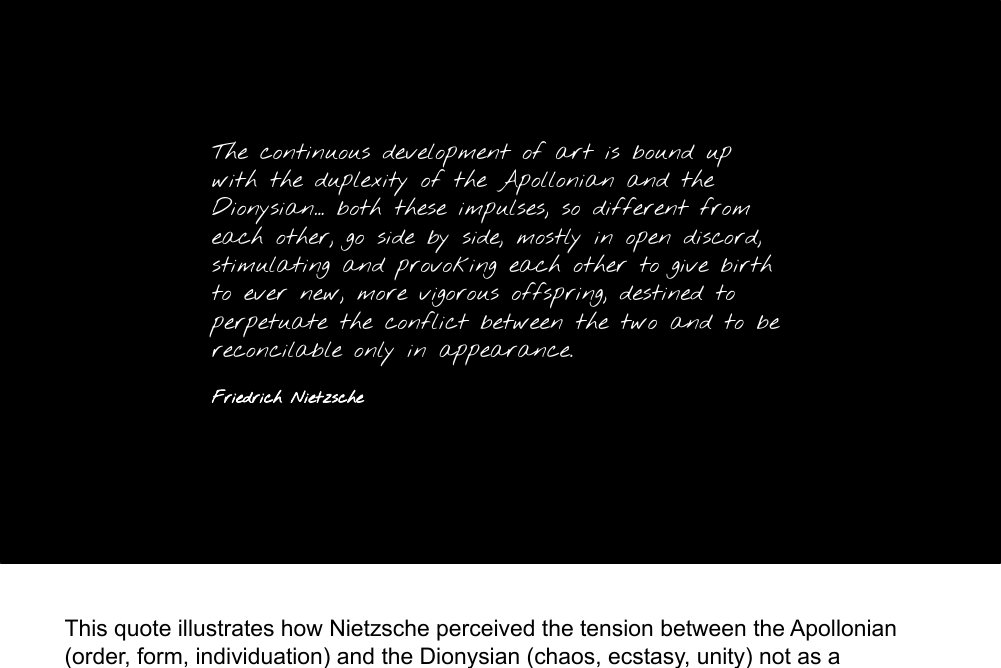
Nietzsche gives the inner face of the story. Greek tragedy held Apollo and Dionysus in tension on one stage, order and ecstasy, and the power to transform lived with Dionysus. Socrates raised Apollo and named Dionysus evil, and we have shed the second pole ever since. A battery needs both its terminals. Music knows this. The score is Apollonian, and the sound comes alive, in you, only when Dionysus plays it, and you never step into the same river twice.
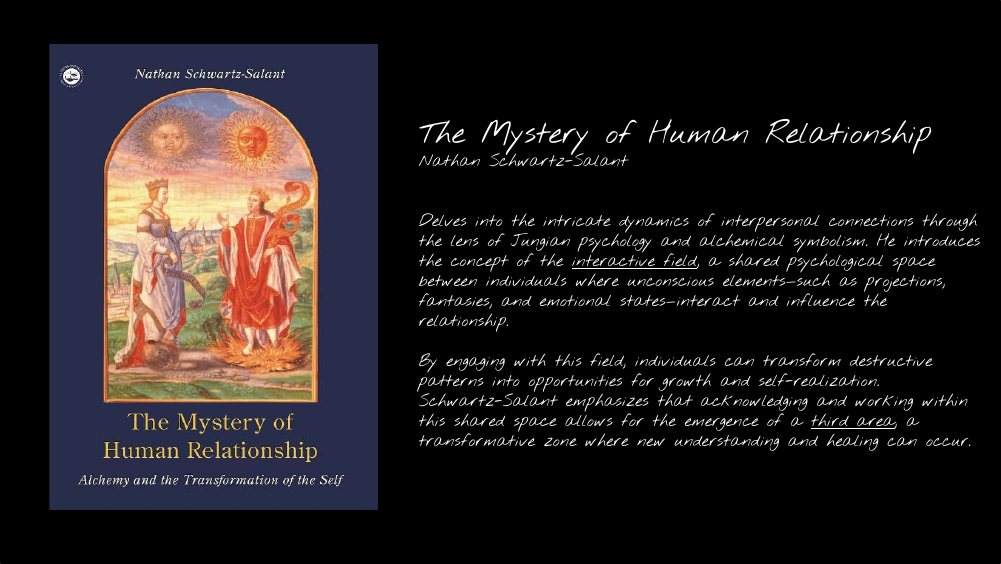
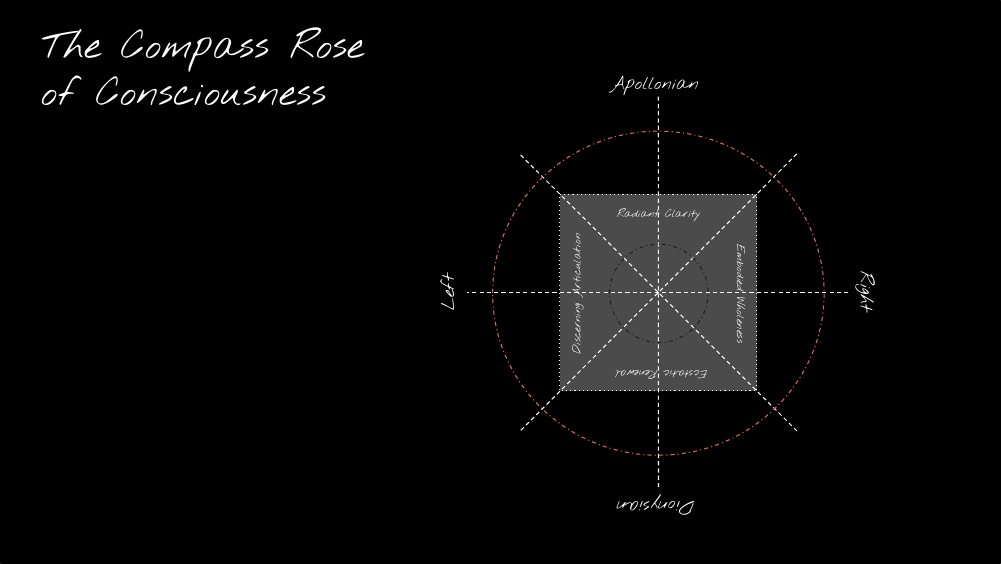
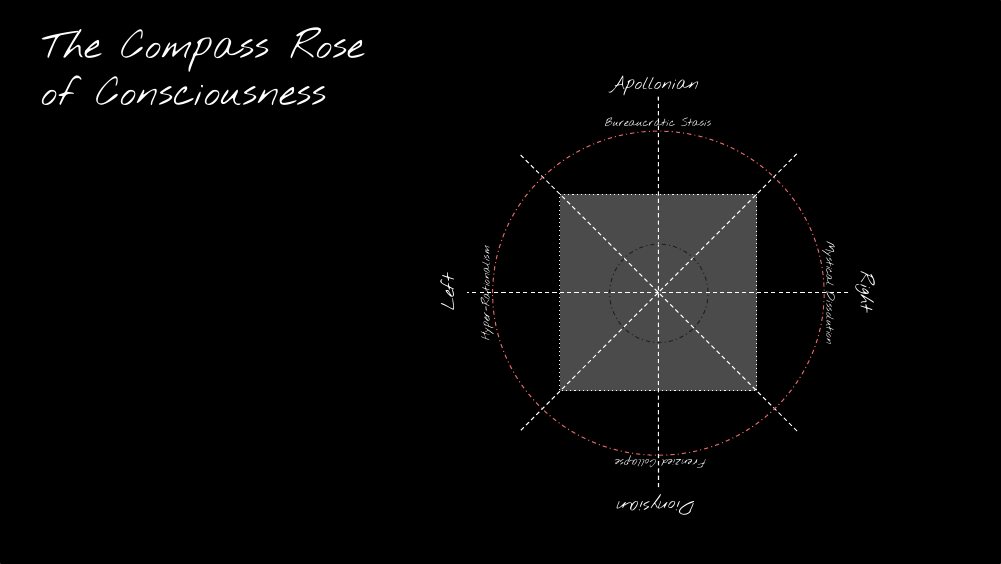
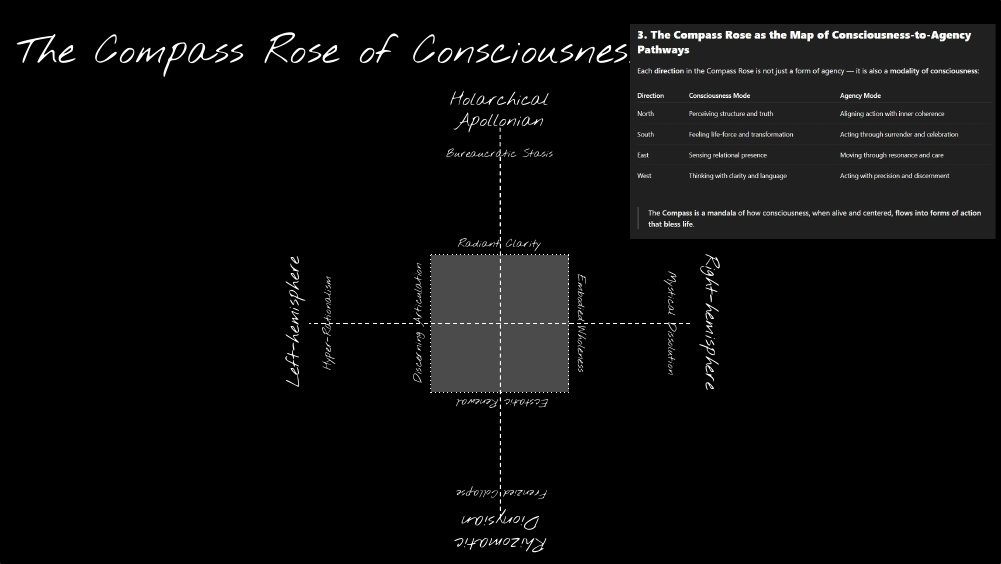
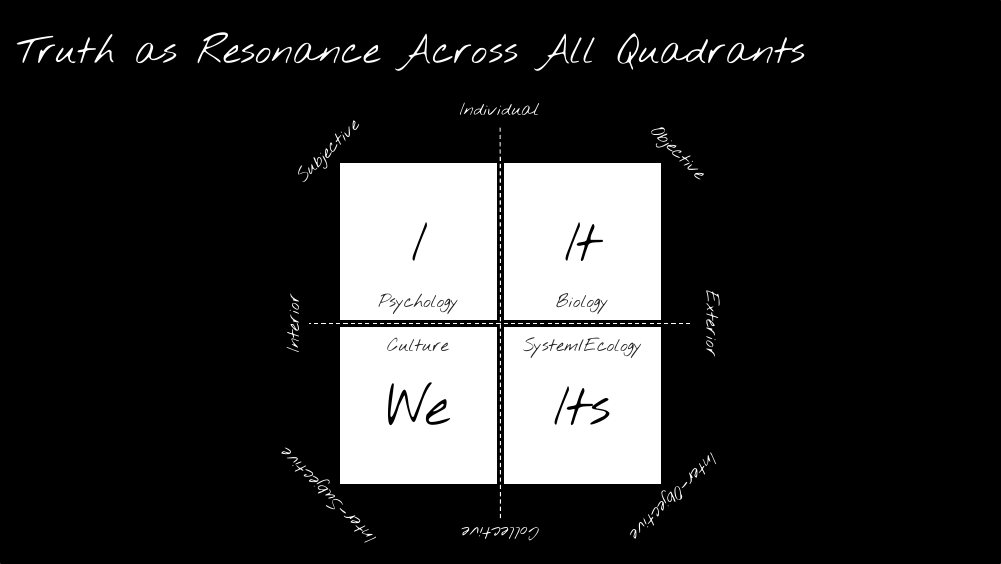
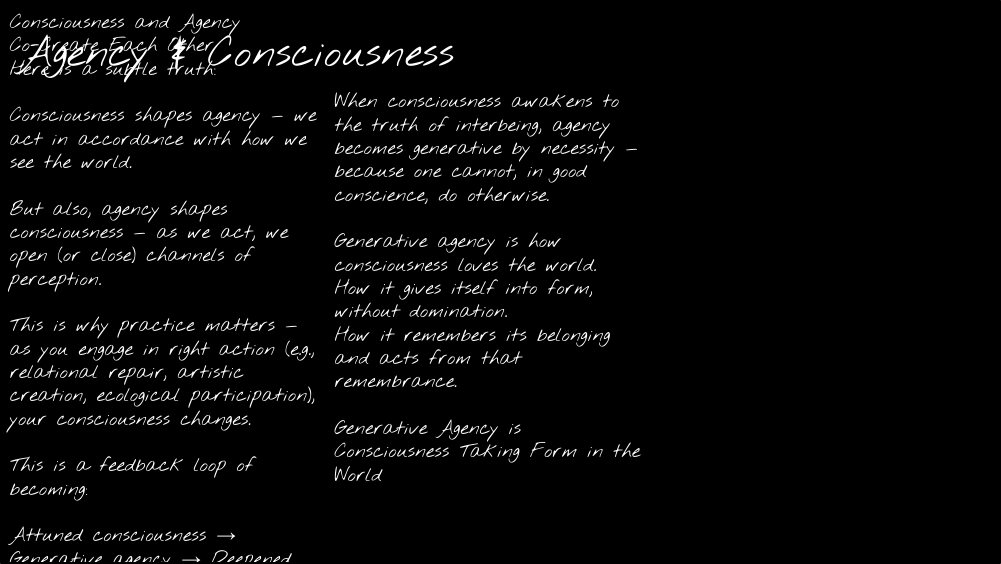
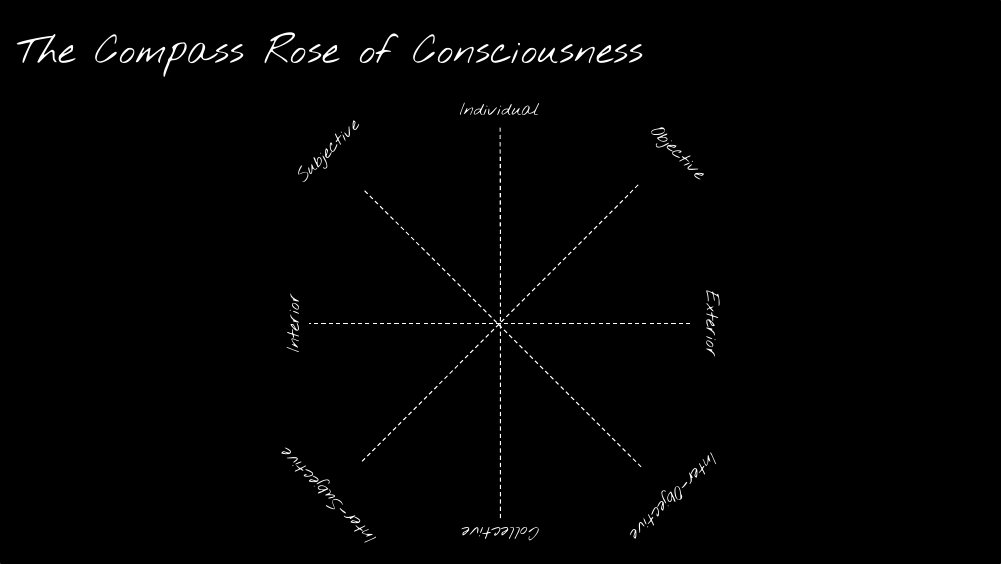
From Nathan Schwartz-Salant I take the third area, where two always make a third, the relationship, and holding that tension lets something new arise. The life is in the paradox. This is the ground of the Compass Rose of Consciousness. I mean the rose, not the bare compass: a compass gives a bearing, a rose gives the whole. Two axes cross at a living centre. East and west are the right and left hemispheres, a mode of being and not a mere function. North and south are the Apollonian and the Dionysian, the inner face of the same thing. At the centre each direction is life-giving: radiant clarity, ecstatic renewal, discerning articulation, embodied wholeness. At the edges each curdles, into bureaucratic stasis, frenzied collapse, hyper-rationalism, mystical dissolution. Here Wilber’s four quadrants find their place, as the resonance by which the right hemisphere knows a thing as true. Consciousness is no longer a ladder. It is a dynamic field, and it flows out into forms of agency that bless life.
So spirituality, for me, is no longer a matter of belief. It is orientation, the recovery of a relationship to depth that lets agency return. Without it we stay in the iron cage. With it, something else becomes possible. That is where I am standing in this inquiry.
This is part two of two. Back to Part 1: Spiritual Intelligence and Ken Wilber’s AQAL.
Transcript
This transcript has been edited for readability. Any passage that could not be made out is marked [unclear].
Claudius van Wyk: Marcus, over to you.
Marcus Link: Wonderful, thanks for being here and giving up your time. I’m really curious to hear what you think. I’m ready to just dive off the diving board. I think it’s the thirty-metre diving board this week.
I wanted to start with a very brief recap, and in particular I’m interested in what still lives with you from the first session we had together. If there’s anything that pops up, please feel free to popcorn it to me, before I start to say what I remember from the last session. I’m really curious to hear what lives for you.
Claudius van Wyk: I think what struck me was the key word of spiritual intelligence. That was the overarching thing: with spiritual intelligence, it provides the vector space for a whole different dimension of exploration. That’s what really struck me last time, that notion. Also, just in terms of Chris’s input from last time, the notion that spiritual intelligence is an availability to all. It’s not something that you work at to evolve into, it’s an availability. And the notion of that being the characteristic of indigenous people, that it is that in which we live and move and have our being. This is a way to open up our awareness into that deeper dimension. That’s what struck me.
Marcus Link: Wonderful. That’s great. That’s on track with what I remember and what I want to talk about. Michelle or Chris, do you want to say something? I don’t want to put you on the spot, but if there’s something that comes up, I’d be really curious.
Chris: I’m looking into my notes, and what I wrote down is: consciousness states and consciousness structures are independent. That was something I wrote down because it was meaningful to me.
Michelle: Yes. For me, Marcus, it was the feeling afterwards: a possibility of hope in the way you’re explaining consciousness. Not something out there, but something that I can work with and expand my beingness through, the journey you were wanting to take. There’s a message of hope.
Marcus Link: Wonderful, thank you. Thank you all for those reflections on what stays with you. I made no specific comment; I just wanted to acknowledge my thanks to all of you for what lives. Three very different reflections, and that’s great for me to know, because I’ve just dumped an awful lot of stuff on you.
I did want to flick through a few slides from last week, so some aspects can live in the space before I move on. Most importantly, I’ve been exploring the connection between the way we use the word intelligence and the way we use the word consciousness relative to spirituality. It was through the work of Ken Wilber that I had quite a few light-bulb moments, in particular his book The Religion of Tomorrow, in which he acknowledges that we are finding ourselves in an age of stuckness with regard to our spiritual development. It seems that the religions are all of the past, and yet he defines spiritual intelligence as one of eleven intelligences that humans are blessed with. It is a key intelligence, he says, because it determines how our self, which is another of the eleven intelligences, develops.
The self, he says, is an average. We have this array of intelligences, where one point is the spiritual and one point is the self, and the others gather around. I imagine it a bit like an equaliser: when we want to get the right sound in music we use the equaliser, and that’s a little bit how our intelligences work, through their dynamic modalities. But our self is determined by the average of our intelligences, and its growth is limited by the development of spiritual intelligence. He is very sad that our culture, Western culture, has very little to offer for spiritual development beyond the confines of organised religion. That’s really a main takeaway. And so he appeals to the major traditions of the world, in particular Buddhism, where he found his home for many decades, to undergo what he calls a fourth turning. Buddhism has been through three turnings, three major developments, and he says it’s time for a fourth. But it’s not just limited to Buddhism, it’s for every religion.
That was a major point that I made. This was a different view of the equaliser. I’m just going to skip forward to today. What I’ve done for this time round is annotate my slides a little bit more. It’s probably a bit awkward during the presentation, as there are so many little ants on them, but I think it’s easier afterwards to remember what it’s all about.
My attempt today is to work with six or seven different thinkers who’ve all had something to say about consciousness and spirituality, and to weave that together into a Western perspective of consciousness and agency. It’s not that I have anything particular to say, like a certain kind of consciousness being better than another. My appeal is that this isn’t about hierarchical views. This is a point that Chris made last time, that Wilber feels very hierarchical, and I fully agree with that. I think there is an aspect of consciousness that is hierarchical, but in its totality there is more to it. I’ve been looking for that, and I’ve articulated something I call the Compass Rose of Consciousness. I don’t know how far we’ll get, but I want to move in that direction, and certainly next time we’ll get to see it properly.
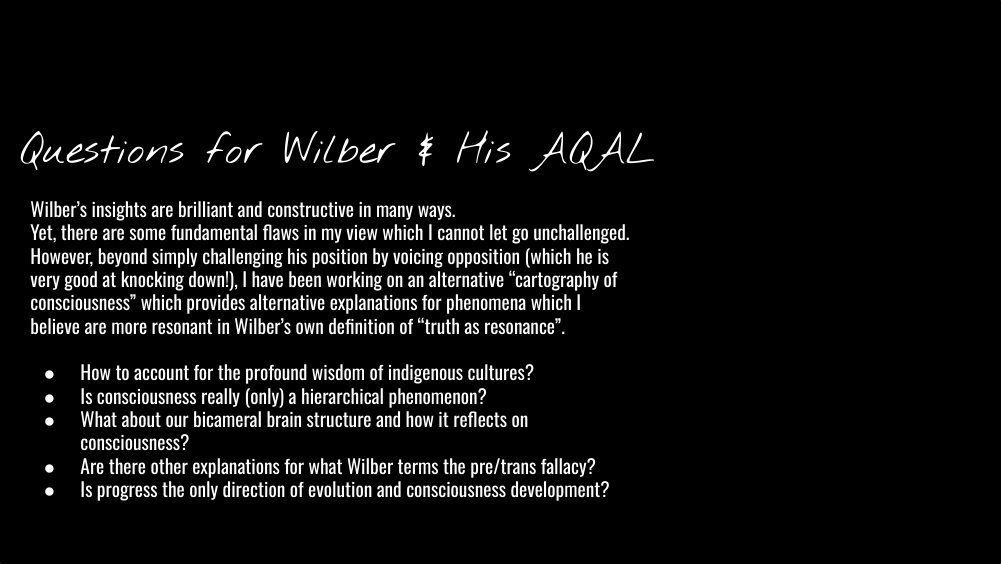
So I have some questions for Ken Wilber, which is really where this all comes from. I think his insights are genius, and I don’t just want to reject them because I have a strong reaction to them, especially because Wilber is very good at knocking any criticism down. His model is so good that he can always tell you: oh, you have a criticism of me because you are here, and that’s why you’re thinking like that. And then you end up thinking, this is like Teflon. I cannot make anything stick, because you’ve protected yourself from any further growth opportunity. So I felt that’s a really strange model. It’s very powerful, but it’s immune to criticism, and I wanted to somehow get in there and have a conversation with Ken Wilber.
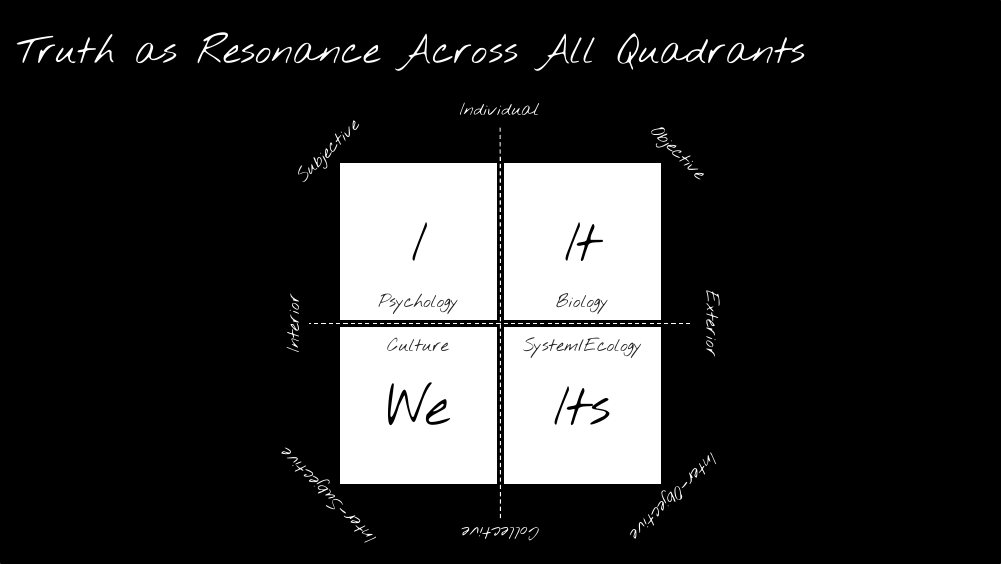
So I thought, how can I do that? I’ve pieced something together, and I hope it’s the beginning of something in that direction. One further piece is that there’s a beautiful articulation that comes from Wilber: he describes truth not as factual truth, but truth as resonance. Truth is a resonant experience that we have, that when the inside and the outside of the world, the subjective and the objective, the singular and the collective, all resonate in me at the same time, when my spine tingles in that way, then that is an indicator that we might be in the realms of truth. And the reason that’s necessary, despite sounding so odd, is that spiritual intelligence is the one of our intelligences that always deals in absolutes.
All other ten intelligences are relative, and we’re very happy normally to admit that it’s relative truth we’re dealing with. But when it comes to our spiritual intelligence, we are always absolutely certain that what we are thinking is the right thing. We encounter that a lot in debates that are far from anything we would articulate as spiritual today. For example, a frequent conversation I’m in is between vegans and carnivores, which I deal with a lot, because in farming the world is split between whether it is right to eat meat or wrong to eat meat, and you will find some very strong feelings on both sides of the debate, with very little appetite to look at the bigger picture. This is an indicator that we’re in the domain of spiritual intelligence, where we are talking about something that matters at a level that goes deeper than anything else. We cannot but be forceful, because it connects to our sense of life. This is why spiritual intelligence is, in Wilber’s view, so important.
So I think he’s onto something really fantastic. I just think the whole model is a little bit too sclerotic. It’s like a skeleton without flesh and blood and bones. It’s a little bit too perfect.
That leads to these questions. How do we account for the profound wisdom of indigenous cultures without just seeing them as lower rungs of the ladder? I think that’s wrong. They aren’t lower rungs. I think they are higher rungs, but they function in a different way. They are more right-hemisphere dominant, and Wilber has absolutely no interest in the left and right hemisphere relationship, which is another aspect. So how do we account for that in his model?
I’ve already mentioned the hierarchical aspect, which I have a problem with. And this is a little bit technical, but he gets on his high horse when he talks to Jungian people. I identify in part as a Jungian; I really enjoy Jung and his psychology. I’ve been in Jungian therapy for nearly thirteen years. He has a particular beef with the Jungians, saying that they are subject to what he calls the pre/trans fallacy. It’s a very technical argument, where he says that some of the things Jungians see as a development of your psyche and consciousness are actually pre-rational, when we really should be aspiring to trans-rational states of consciousness. I think that is, again, being stuck in a hierarchical understanding of consciousness, which is wrong. We could explore this another time; it’s so technical it’s just dull and boring, so I’m not going to say anything more about it.
I also think that progress isn’t the only direction for the development of consciousness. I think that’s a very left-hemisphere-dominant understanding of time and of how the world actually works. I think cyclical is very important too, and sometimes regression is absolutely necessary in order to progress. It’s not acceptable to me to be so obsessed with progress.
So those are just a few questions, and that’s led me to explore the following.
I’ll set the frame with a quote from Goethe. It’s from his poems which are called the West-Eastern Divan. The divan is both a chair that you lie on and, in Persian, a collection of poetry. He was particularly enamoured with the Persian poet Hafiz, and he essentially dedicated a set of poems to him, written in German but organised in the particularly Persian way. Four lines from that very big work go like this. I translated them from the German, because I didn’t like the translations I found. He says: who cannot account for the lessons of three thousand years may remain in darkness, uninitiated, may live from day to day. Who cannot account for the lessons of three thousand years may remain in darkness, uninitiated, may live from day to day.
Now, when I first came across this, I was both deeply fascinated by it and yet also felt a certain sense of schoolmasterliness, as if there was something I needed to know, otherwise there was a sense of worthlessness. But I’ve overcome that since, and realised that he’s saying the exact opposite. He’s saying that beyond the schoolmasterliness there is an initiation we need to go on, because otherwise we live in this fallacy of the present moment that is actually not alive. It’s a present moment that has no past and no future.
To a certain extent, I think that’s precisely what time feels like at this point in Western culture. For many people we live in a bubble, and it doesn’t seem to have a trajectory. We are just maintaining this bubble, and in particular, with technology, we’re trying to arrest that bubble. Meanwhile, we know how to measure the biodiversity of a forest, but we can’t stop its degeneration. There is a very strange relationship that we have with reality and the world at large, and Goethe brings in the theme of time. He brings in a role of initiation and something about how we are positioned as individuals in that. I’m going to call that agency. He says the initiation we need is one into our own agency, and it has something to do with time and how we place ourselves in that. That’s why I’ve chosen this, and I’m going to unpack it now with the help of a few other people, like Max Weber.
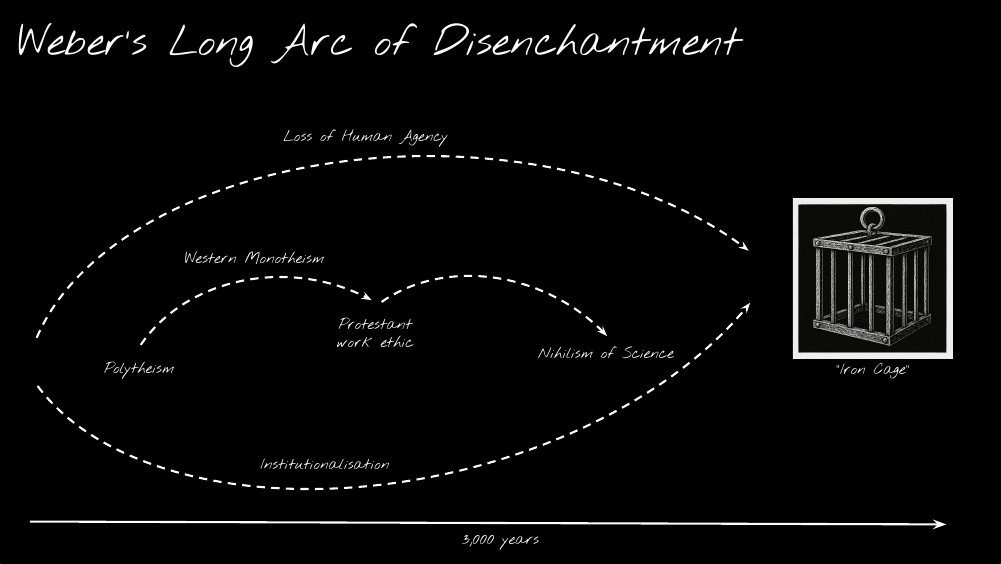
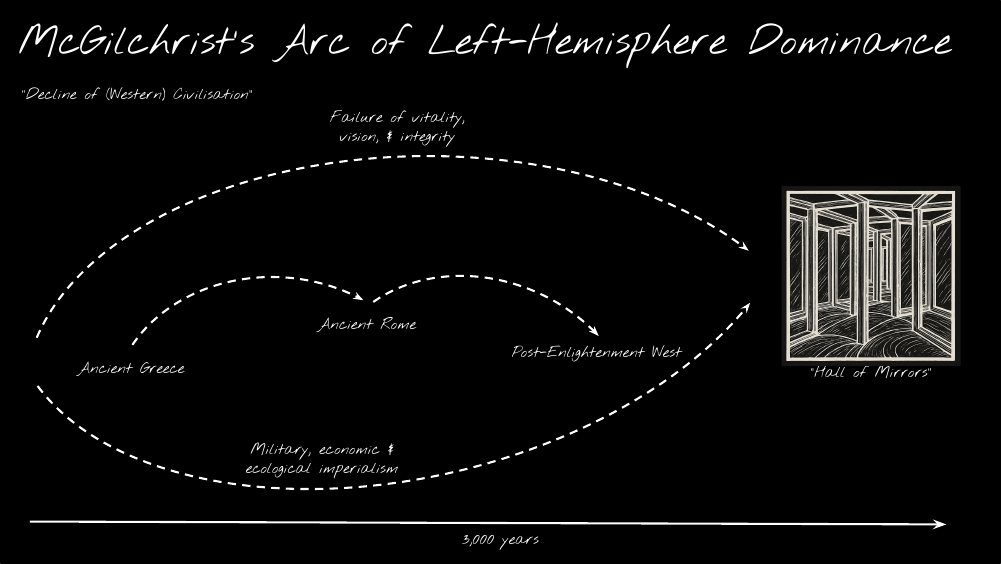
Max Weber is a German sociologist. If you haven’t heard his name, you might have heard the phrase he coined, which is disenchantment. He describes the entire Western culture as a long arc of disenchantment, which I’ve tried to draw up here. There’s a timeline right at the bottom: three thousand years. So, sometime three thousand years ago, we begin in ancient Greece, and we arrive in today’s age. This age of today he describes as the iron cage. We have lost human agency. We have gained institutionalisation, and this has locked us into our jobs and into the economy, in an iron cage where we don’t have any agency.
How did this come about? He doesn’t say it’s very simple, but he has drawn a picture that is actually very simple to understand. He says we have been on this journey out of agency and into institutionalisation over a series of events that can be characterised as leaving polytheism and replacing it with monotheism. We arrive at one point, in its darkest place, which is the Protestant work ethic. From that place we then replace the monotheism of faith with the monotheism of science, and science is not something that can give you meaning, although it appears to give you meaning. So we end up in a space where science promises to give us meaning, but it has actually uprooted it out of our own sense of purpose, and we end up with nihilism. We can’t find our way out of this, because we’ve given away our own agency to do something about it, to the institutions which govern our daily life. The worst for him is to have to work in order to live within this institutional state of being.
This was his response to students at Munich University, where he taught, when they asked: what is the point of work, and what kind of work do you recommend, Professor Weber? He said, well, you’re going to have to work, because you’re going to have to afford to live. But what I really recommend is not work, but vocation. You need to find purpose. You need to declare it yourself, because the institutional world is not going to do it, and it’s going to do its damnedest to take your life energy by way of your agency. Because you have to work, and because you have to get an education to do the work and so forth, it’s going to channel your life agency into its institutions, and it’s going to leave you without purpose.
That’s a very dark picture of three thousand years of Western civilisation, but I actually think it’s fairly accurate. He says this whole thing ends up with an absolutely bizarre situation, which is that the human being has become a nullity. He says we are specialists without spirit and sensualists without heart, which is the same as a nullity, and yet this nullity imagines that it has attained a level of humanity never before achieved. So there is a hubris and an arrogance to this way of being, and yet it neither really has feeling nor has it got embodied spirit in its thinking. It’s caught in the abstraction of an institutionalised world. And the phrase disenchantment, just to bring his definition of it alive as well, is that we live in a world in which all mystery has been replaced with calculation. All the mystery of the incalculable forces, the magic as it were, has gone away, and in principle we have this belief that everything can be calculated. That means, in his view, that the world has been disenchanted.
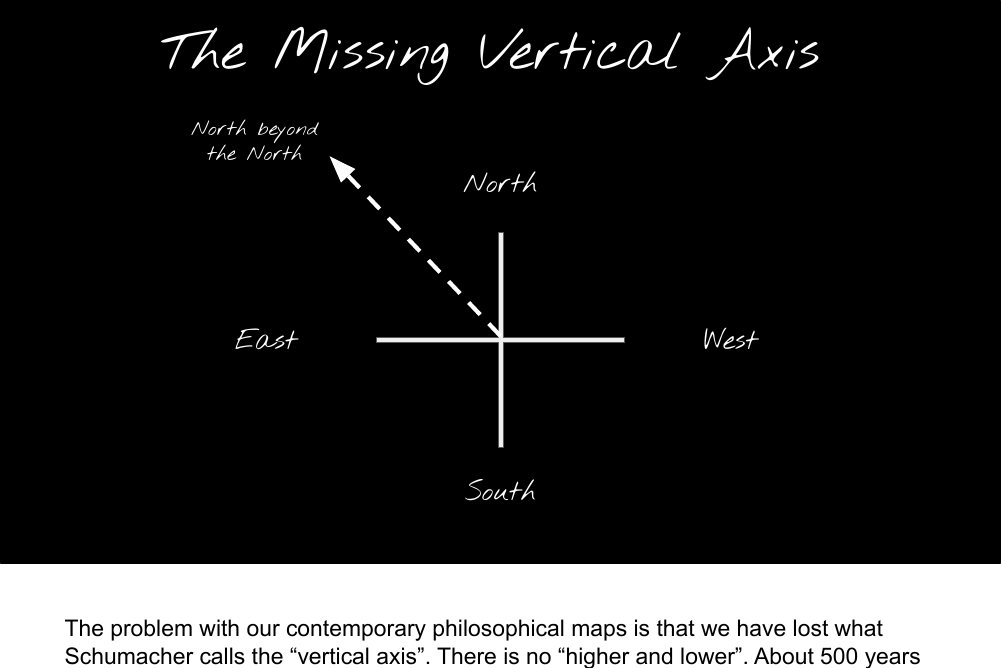
So that’s Max Weber as my first offering for today, which is one way of describing the loss of the vertical axis, which is one way I started my first talk in this series. Another way of looking at the vertical axis would be to call it the north beyond the north, and that’s a phrase I’ll come to in a minute. What it really means is that the north, in a way, is actually one of the flat directions, and what we’re looking for is an upward direction. The vertical axis is that which connects us to the higher truths, and it’s become flattened through, in shorthand, reductionism. Everything is given a metric, but no metric really has value. That is one way of describing where we’re at today.
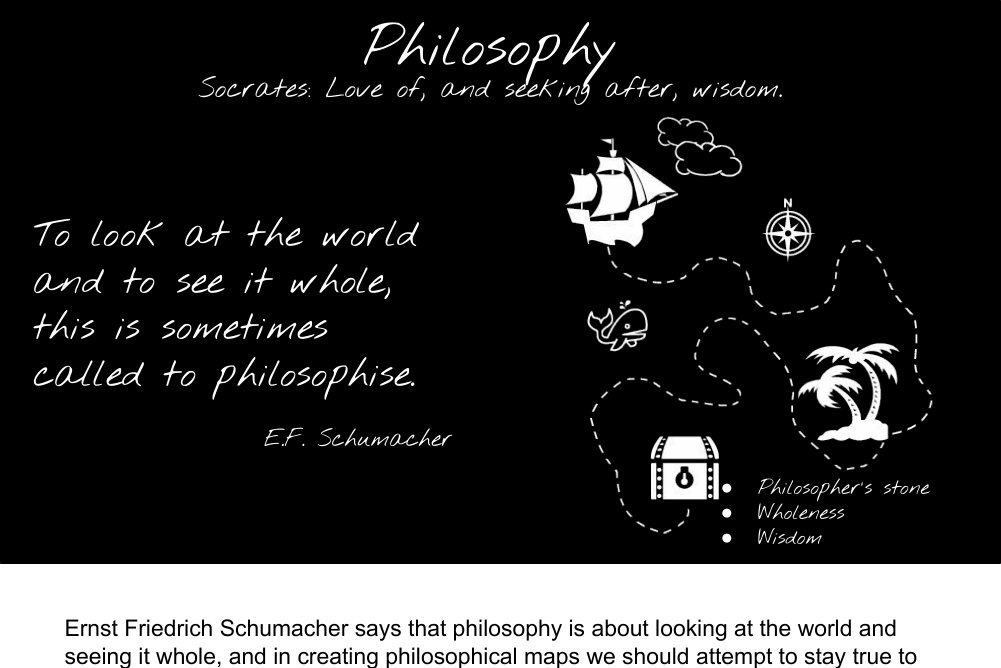
I described my fascination with Schumacher’s wrestling with this, and how, in my own biography, he articulated the vertical axis to me for the first time. He says the whole business of philosophy is to look at the world and see it whole, and this is sometimes called to philosophise. So that’s my origin story of why I am actually talking and thinking about this at all.
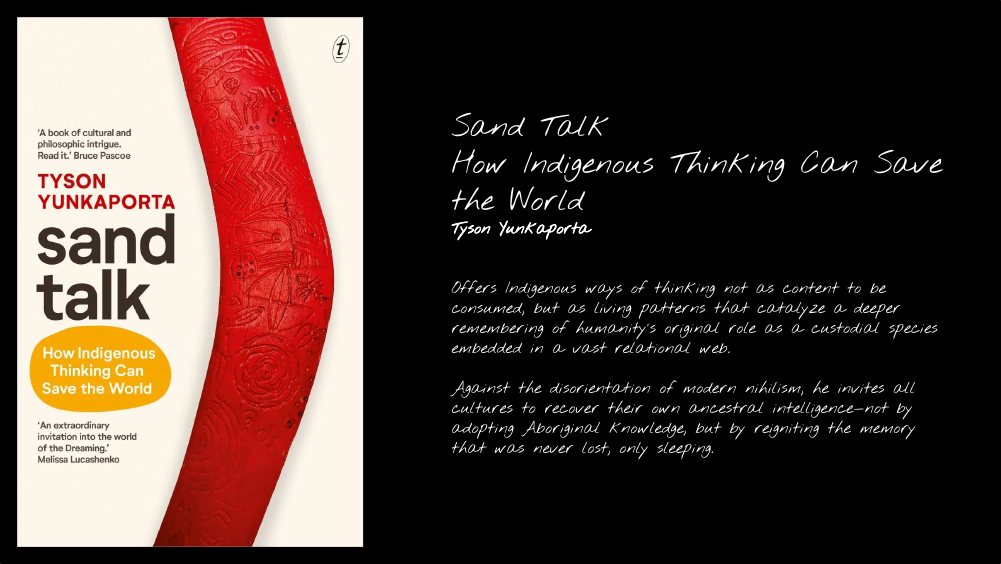
So I now want to take a totally different perspective on Western civilisation, through the eyes of an Australian Aboriginal thinker, Tyson Yunkaporta. He’s not Aboriginal in the strict sense; he actually has an Irish mother, and this is a big deal for him, because, living in Australia, he is very aware that he is neither properly Aboriginal nor properly European. Both cultures won’t let him in properly, and yet, having been adopted into an Aboriginal family, he feels thoroughly Aboriginal. He has this desperate attempt in his life to bring some of the depth of his culture to the European, Western, colonial culture that has made the life of his people so very difficult.
As a reminder, we, the Australians, accepted Aboriginals as being human only in 1976. It’s a little bit like the conflicts that South Africa and the United States have been through, and the Europeans as well, in that we’ve had a difficulty acknowledging other people, based on their skin colour, as human. He feels this very keenly, and yet also feels there’s a very strong meaningfulness that his culture has to offer. He did something very clever in his book, Sand Talk: he doesn’t offer us a book on Aboriginal consciousness, he offers us Aboriginal reflections on European, Western consciousness. That’s a very different thing, and it’s very powerful.
Just as a snippet, he talks about our form of education, and while this is said tongue in cheek, there is certainly a degree of truth to it. Western education, the institutional form of education, in his view, is what we really do to wild animals when we domesticate them. But is that the right thing to do with human beings? That’s the question he asks, and he brings some very powerful examples of what it actually does to you when you’re educated in an institutional way. Something in you, the wildness in you, is taken away, and in fact the whole idea of wildness is created as something that you are not. But I’ll leave that for another day. It’s a really important book, I think, and it’s very interesting to think about Western culture with that invitation to look at it through the eyes of an indigenous culture.
I’m going to read you this quote from him, which goes like this. I have previously talked about civilised cultures losing collective memory and having to struggle for thousands of years to gain full maturity and knowledge again, unless they have assistance. But that assistance does not take the form of somebody passing on cultural content and ecological wisdom. The assistance I’m talking about comes from sharing patterns of knowledge and ways of thinking that will help trigger the ancestral knowledge hidden inside. The assistance people need is not in learning about Aboriginal knowledge, but in remembering their own.
So one of the things he’s on about is that we all have this knowledge inside us, it just needs activating. That’s what initiation rites are about, and that’s what education should be about. But our form of education is often about removing this sense of deep knowledge from us and replacing it with something else.
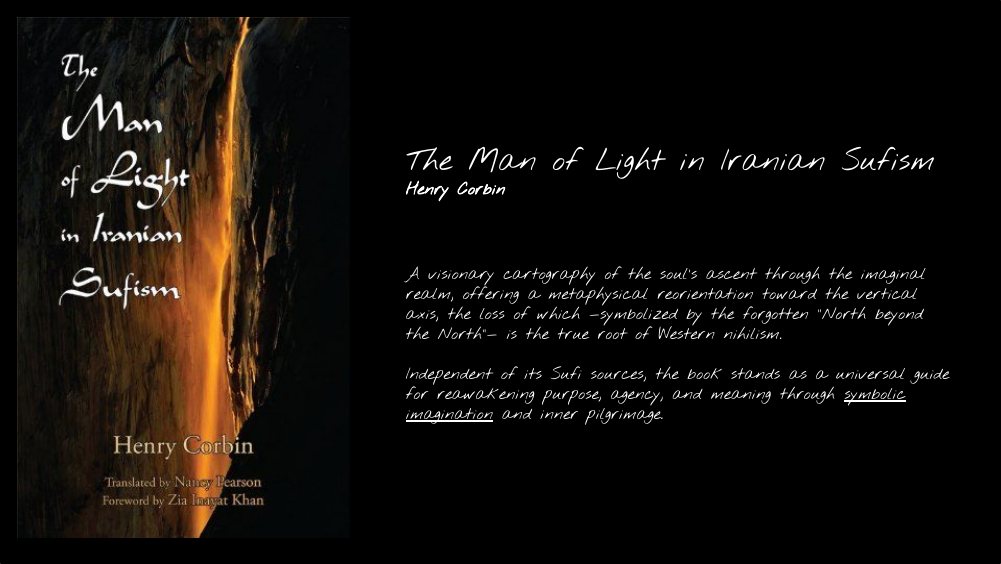
I come to Henri Corbin, a French academic who fell in love with Persian, or Iranian, Sufism. He ended up spending much of his life in what is now Iran, studying the Sufis there. What he was so fascinated by was the man of light, as they call it. Their meditation is one of following the man of light, who is an inner guide, and what they learn to see is figures of light, different colours. It’s related to the rainbow, very much the rainbow colours, as Ken Wilber also uses them, but they’re using them not in a factual-knowledge kind of way; they’re using the rainbow colours in a meditative kind of way. They have a lot of angels in their mysticism, the Sufis.
He has mapped and followed their approach, as an anthropologist you could say, and he’s absolutely persuaded, like Schumacher, that the West has lost the vertical axis and that it needs to recover it, but it can’t recover it without an inner practice. He talks about something he calls the north beyond the north, as I referred to before. It’s the north that is above us, rather than in the north. It’s a very interesting way of looking at things, because it allows you to understand why, in the Middle Ages, the maps were geocentric and why the east was in the north.
Just as a little rabbit hole: if you look at an old map, you might have seen one, sometimes they’re called a mappa mundi, where you have the angels and God at the top of the map, and then a spherical earth on the inside of the map, but it’s tilted in such a way that Jerusalem sits in the centre, and then the east is not on the right of the map, but goes up towards God. The north is over to the left, and so the map continues in its normal orientation. Corbin’s way of explaining what’s going on here is that this is not an exoteric map, it’s not a map about outer realities, it’s a map about inner reality. The sun rises in the east, and we often see the East as the bringer of light, also in the way we think about religions. The Indian culture, for example, or the Persian culture, is always related as the culture of light relative to Western culture, and it’s therefore sitting in the north, because the north is where the light comes from in a spiritual, consciousness sense.
So for him the whole issue of consciousness is an ascent. We have to go upwards, and follow the visions of light, and the way we follow the visions of light is that we work with our imagination, not as fantasy or as an escape route in terms of escapism, but with imagination as a way to explore the inner realities of the world, which are universal rather than subjective. But the place in which we discover them is our inside. We need to go inwards in order to go upwards. That’s how he articulates it.
So he has, in common with Schumacher and Weber and Yunkaporta, this idea that there is a vertical axis and we can access it, and we access it not through outer knowledge but through practising an inner knowledge. In his case, he talks about an ascent, and he uses the Iranian Sufis as an example. While he thinks this is a universal phenomenon, it is simply the Sufis that have been the content matter of his research.
A quote, just to bring this home: orientation in time refers to the different ways in which man experiences his presence on earth (he’s a bit of an old-fashioned writer; he didn’t say woman) and the continuity of this presence within a kind of history, and the question as to whether this history has a sense, and if so, what sense. So for him time is really important, and he recognises that all indigenous people have always had a sense of time. It might have been completely different from any other indigenous group, but what they had in common was that they were able to place themselves within some kind of origin story, and that this origin story gave each individual life a meaning. This is a fact that Western culture does not have. It has the Big Bang and so forth, but the Big Bang is essentially an accident, and it leads to meaninglessness, like Stephen Hawking’s quote that human beings are just chemical scum on a meaningless planet in a meaningless galaxy.
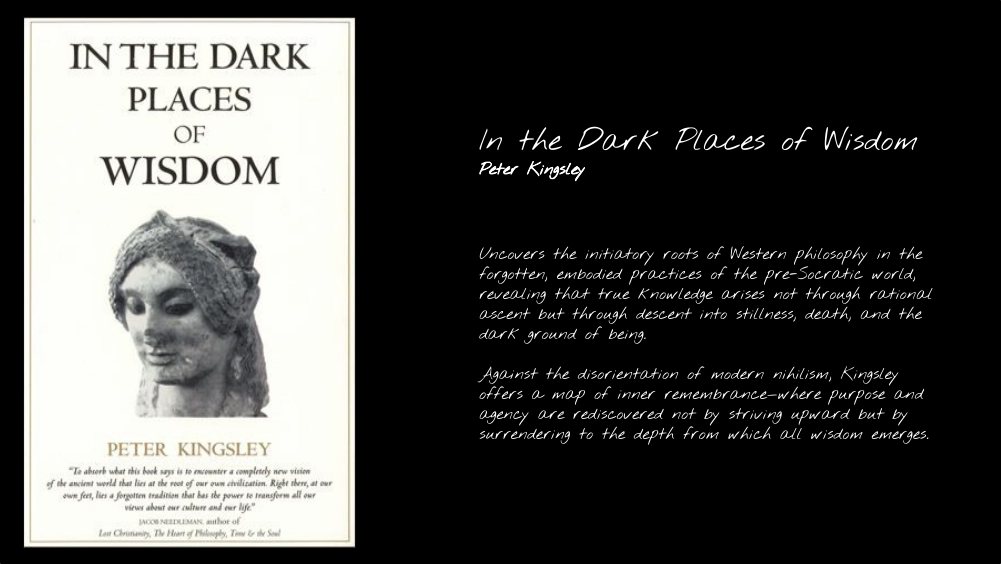
Here’s another one of my very favourite and very dear researchers, Peter Kingsley. He’s written a number of very interesting books, but the one I found most inspiring is called In the Dark Places of Wisdom. He also agrees that one requires a placement in time in order to understand one’s meaning. He believes that, while we of course should explore other cultures, our own sense of spirituality is hidden in plain sight within our own culture. He says that in order to understand what that is, and what our meaning is, we need to go back to the beginning of our civilisation, to the very early days before Plato, into the pre-Socratic era of Greece, where, he says, the origins, or the seeds, of Western culture were planted in the thought-work, for example, of Parmenides and Empedocles, two philosophers who were grossly and deliberately misquoted by Plato. That’s his case.
So he makes the case that they were onto something, but Plato took only part of what they were onto and made it his own by putting the words into Socrates’s mouth, rather than saying honestly that this is from Empedocles and from Parmenides. This had to do with the fact that Socrates and Plato are from Athens, whereas Empedocles and Parmenides were not from Athens, and Athens had this very strong need to try and subjugate all other parts of ancient Greece by essentially taking war to them. They said something in those days already that I have heard Tony Blair and George Bush say, which is that they were bringing democracy. The Athenians used to say that they were bringing democracy to the other states of Greece, and they had a very strong need to talk about a united Greece. There was never such a thing as a united Greece. In ancient Greece they were always at war, and the only time they had peace was during the Olympics. The Olympics was a time of great outer and inner conquest, as it were; the combat was, as we know, not just in games but also in poetry and in oratory and rhetoric, and so forth.
But Peter Kingsley takes us back to those times, and he says it is in the work of Empedocles and Parmenides, when we understand it properly, that we see that the West had a meditation practice as powerful as Eastern meditation, but it is called incubation. It’s called incubation, and it is still practised by the Sufis. So the remnants of incubation are with the Sufis, but it was practised throughout Western culture, especially in Greece. What it involves is a deprivation of the senses, by going into a cave and lying down, not sitting up, and essentially going on a journey of descent into the underworld. If you have just the vaguest memory of Greek myths, then you’ll know that there’s often a dealing with the underworld, where the hero goes into the realm of death. The realm of death is not just the realm of death in the sense of dying at the end of life; the realm of death is the realm of the death of the senses. Peter Kingsley’s point is that, whereas the East, by and large, is about living without the senses, in an ascetic tradition, the West is about the celebration of the senses, and finding the access point to the spiritual world through the senses rather than beyond the senses.
So he creates this contrast between these different traditions, and the consequence of this was that leadership in all of the Greek nation states, other than Athens, was one that was practised through incubation, and the leaders, or elders as they were also known, were both leaders and at the same time spiritual practitioners. Any law, any pronouncement that was made, came about through relationship with the gods within. When there was a problem to be solved, one would not discuss it or measure it or come up with a plan; one would go and do incubation, and meet with the gods, and then take away the offering that was given in the inner practice, and this would be discussed around the fire until there was a consensus. That is a very different kind of governance structure, which is not like democracy, one could say, but it has a connection to the inner world which democracy does not. I don’t know what the resolution of that is, but there is much more that we have inherited from ancient Greece than democracy and a few nice myths. A lot of it has been lost to obscurity, and Peter Kingsley’s point is: go back to the early days, and you will find in those seeds a whole tradition that was much greater than the rationalism and the logic that Plato made of it. In fact, rationalism and logic are two of the flowers of those much wider states of consciousness that were deliberately practised in order to get access to rationalism and logic. Which, when you think about the way the left hemisphere and the right hemisphere of the brain work, is a very powerful understanding of how we can access them, which was lost to the West because we overemphasised the left.
The quote from Peter Kingsley, just to bring this home: perhaps the simplest way of describing the situation would be to say that two and a half thousand years ago, in the West, we were given a gift, and in our childishness we threw away the instructions for how to use it, and as a result, Western civilisation may soon be nothing but an experiment that failed.
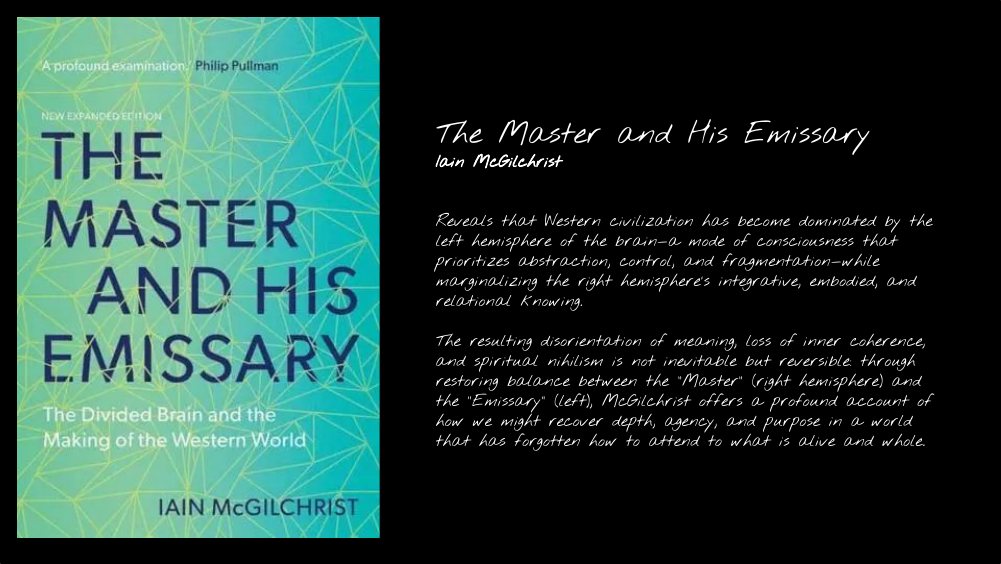
Which takes me to Iain McGilchrist. Iain McGilchrist uses a story by Nietzsche about the master and his emissary in order to frame his entire work. He essentially says that the left hemisphere of the brain is the emissary and the right hemisphere is the master, and that in the course of Western civilisation the emissary decided it was more powerful than the master, and because the master couldn’t even articulate himself properly, he was actually quite useless. What we needed to do, then, was to put the master in prison and get on with the business of life on our own. Which is how the story by Nietzsche goes.
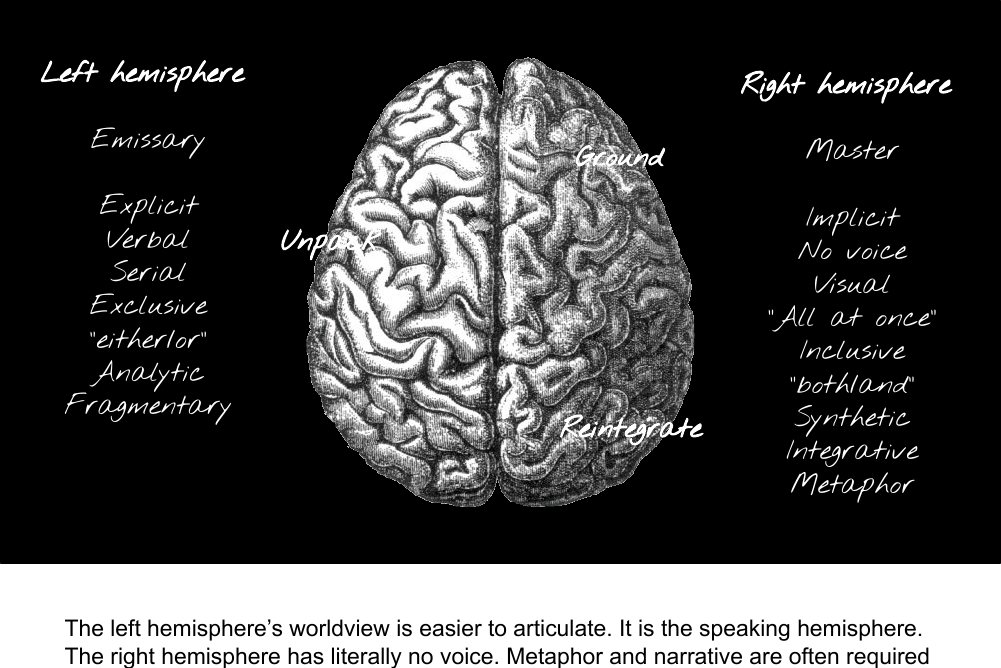
This is a very good analogy for what’s happened in our brain structure. The left, which is normally supposed to serve the right (if we just very broadly summarise neurological developments in humans), is very important, but it plays an inferior role to the right. The right is supposed to understand the bigger picture and then invite the left to solve the problem, as it were, and the left is then supposed to give that back to the right in order to create an integrated understanding. But the way our brains now work in Western culture is exactly as Max Weber said: we have an institutionalised form of understanding things, rather than a right-hemisphere, holistic understanding of things. So the left has gone through with it, and it has gone through with it in such a way that the entire world we create, in terms of cities, the architectural forms we build, even the art we have and the way books are printed and the way we are educated, are all only left-hemisphere artefacts that reinforce our understanding that the left hemisphere is right. So what it does is lock us in.
He uses a different metaphor. He doesn’t use the iron cage, he uses the hall of mirrors. He says the left hemisphere has over time locked us into our own brain. So the origin of this is not something far away, it’s within us. It’s within our neurology, and through the way we activate our neurology with the wrong rites of passage that undermine something that once functioned very well, and now means we have no access to vitality, vision and integrity. We are essentially living lifeless lives, is one way of putting that.
He, like Weber, sees that there has been about two and a half to three thousand years of development, which coincides wonderfully with Peter Kingsley’s way of going back to the beginnings of Western civilisation, and coincides wonderfully with the way that Henri Corbin looks at where we need to go in order to understand our history. McGilchrist’s development of Western culture goes from ancient Greece to ancient Rome to the post-Enlightenment West. The reason he talks about these three different eras is because they have each ended in the decline of those civilisations. Ancient Greece gave way to ancient Rome, and Rome gave way to what we call the Dark Ages, which is the left hemisphere’s way of describing the age of faith. That’s why we call the Enlightenment the Enlightenment, because that is the reawakening of the left hemisphere, where it again begins, through renaissance and enlightenment and the age of science and industrialisation, to teach us that this is the way out of darkness, and straight into the sixth extinction event and climate change, for example, just to name a few existential crises that are rooted in left-hemisphere-dominant ways of being alive.
Where Weber talks about these two arcs, one the loss of agency and the other the increase of institutionalisation, Iain McGilchrist talks about the failure of vitality, vision and integrity, and the increasing military, economic and ecological imperialism. So, if you want, the left hemisphere is also a deeply colonial, imperial way of being alive. It’s an extractive way of being alive. The irony is that that’s entirely necessary within its place. If you don’t have a left hemisphere that’s good at grabbing, you are never going to be able to feed yourself. Chickens use the left hemisphere in order to identify a corn against the background of, say, gravel; they are able to peck the food rather than the gravel. So within its right context, extractive approaches to life can be life-giving, but when they take over they become so extractive, so degenerative, that they undermine life.
So Iain McGilchrist’s whole point is that we have to recognise not that the left or the right is better, but that we need to find the right balance. He still thinks we’ve got hope, because we can understand this, but what exactly we do about it, he’s not so sure either. One of the things is that by talking about it we can begin to recognise this, and we can begin to recognise in our own selves all of those things that are colonial and imperial, and many other things we might describe as bad, and we can recognise in that also that there isn’t just a badness but also a life-givingness. Which I think is a very important part I’d like you to bear in mind as we move on through my avalanche of slides.
We come to Friedrich Nietzsche. I think many people will say he’s probably the most misunderstood philosopher in the West. I think many people mean that, like I would have said of myself until very recently, that I don’t even know what he’s talking about. But it suddenly dawned on me recently that I’m beginning to understand what he was talking about, when I happened upon a biography of Nietzsche which really fascinated me. I realised that all the books he wrote are about the same thing. They are all about human agency in an era, or in an age, where humans seem to have no agency. He anticipated the First World War, and he was horrified by the age of industrialisation. He felt we’ve made an enormous mistake, and he says this mistake started with Plato and Socrates.
That’s when, for me, the penny started to drop. There are all these people, all these books that have been lining up on my shelf, and they all talk about the same thing. They all see consciousness as a phenomenon and a real gift in Western culture that was at some point lost, and they all point to the same arc of history, where something happens with these guys called Socrates and Plato, who are the heroes of philosophy, the heroes of scientific discourse, the heroes of so much. And there are some people who say: not so, not so, be very careful what you believe in, because it could be that these guys were also very clever in a way that hid something very important for us, for their own advantage. There’s a whole reason why Socrates and Plato might have behaved as they have, and I don’t want to go into that. I’m not saying they’re bad, but I’m saying they missed out an enormously big and important piece, which is that they transformed wisdom into philosophy, and philosophy became a very lifeless discipline in the course of the West.
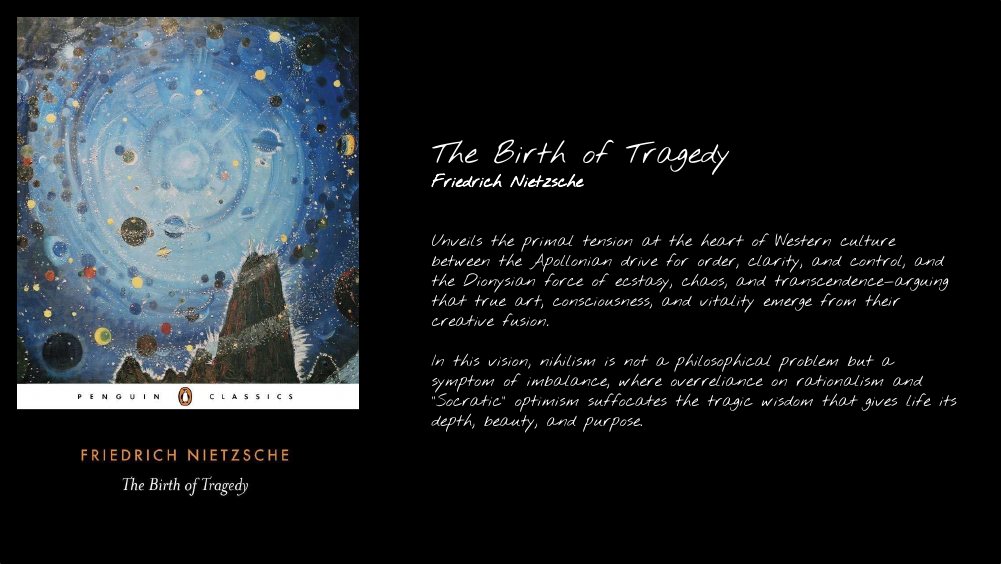
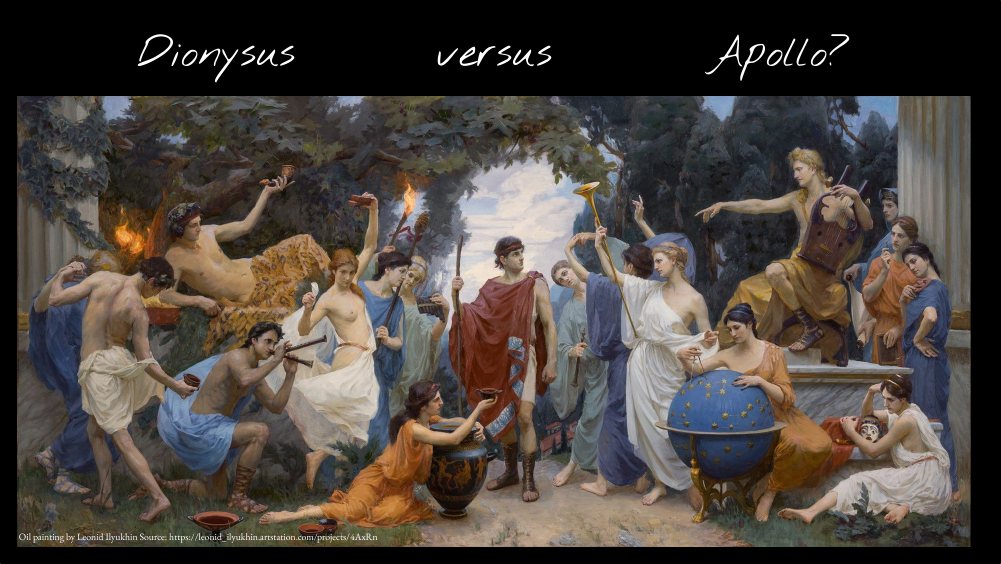
Anyway, Friedrich Nietzsche wrote this book called The Birth of Tragedy, and when it was first written he called it The Birth of Tragedy out of Music. He said that Greek tragedy, this art form, the performance art of Greek tragedy, which had its heyday before Socrates and then started to give way to more philosophical forms of art (so there is something very interesting that happens to the appreciation of art forms in Greek culture), he says we lost something when we lost the Greek tragedy. What did we lose? He says there are these two gods in Greek culture: on the right we’ve got Apollo, and on the left we’ve got Dionysus. The way we generally think about Dionysus and Apollo is that Apollo is the god of virtue and Dionysus is the god of chaos, of bacchanalian drunkenness, of orgies, of food beyond sense, of sex, of all sorts of crazy things that the Victorians banned. Apollo’s the guy who’s good, and Dionysus is the guy who’s bad.
Now, what Nietzsche says is that Greek tragedy does a very beautiful thing. It takes Dionysus and Apollo and puts them in a tension on the stage, in a theatre, and it brings Apollo’s structure and articulation and refinement, and Dionysus’s wildness and life, but crucially transformation: the ability to transform lies with life and Dionysus. So these two things came together into a play on stage. Aristotle called it catharsis, but in calling it catharsis he missed out that there is a tension at work that works across a spectrum, and it needs the two poles, like a battery needs its two poles, in order to really work. Because if you ban one of those, you lose the whole thing. This is why music is so important.
Nietzsche loved Wagner, and he dedicated his book The Birth of Tragedy to Wagner, and so there’s a whole other story that brings the Nazis into this, which is very complicated and dangerous, but we’ll go into that another time. What Nietzsche was talking about here is that we need the tension between Dionysus and Apollo. We don’t need Apollo at the expense of Dionysus. But what happened with Socrates and Plato is that we began a trajectory of moral and ethical discourse in which that which was Dionysian was labelled bad or evil, and we see, with the Stoics for example and others, an increasing move towards Apollonian structure at the expense of Dionysian transformation. This is a total dilemma, and this is a way of experiencing, as it were, what Iain McGilchrist talks about when he says the left and right hemisphere of our brain. Nietzsche talks about the Apollonian and the Dionysian as two ways of experiencing what the left and the right mean, if that makes any sense.
So these are two parts of our brain. Neither of them is bad. What’s bad is when one of them starts to dominate in the wrong way. Nietzsche has very delicately explored the inside of the subjective experience of what right-hemispheric consciousness looks like and what left-hemispheric consciousness looks like, and he’s called that the Dionysian and the Apollonian. The interesting thing is that already in the Greek tradition, and then later with the Romans, and then again in the Renaissance, exactly those characteristics and qualities and attributes are projected onto these gods. You’ve got the transformative capacity and the power of life, but also the chaos, in Dionysus; and the total structure, all the way to rigidity, bureaucracy and mathematics, and the beauty and splendour of harmony, all with Apollo.
But why did Nietzsche say that tragedy is born in music? Well, he experienced that. When you look at McGilchrist’s book about the left and the right hemisphere, you’ll find that when he talks about music, it is one example where we actually have to use both hemispheres in order to create something. Music is annotated in a very structured way; it uses its own language, and so forth. This is Apollo. But that which comes alive when you play it, after you’ve been through the Apollonian discipline of learning the instrument, is that you move back into Dionysus, and then the notes on the paper transform into life. And then you can hear it, and when you hear it, it’s not only produced by the instrument and the musician, it is actually produced in you. When you hear the same piece, or read the same poem, or read the same book twice, you’ll never go into that river, as the famous Greek philosopher said, twice. You cannot go into the same river twice, because it is always a new event. It’s always transformative, it’s always alive. This is what is so important about Nietzsche’s work for me: he recognised it’s not one or the other. Good and evil are not in the one or the other; good and evil arise when we choose one at the expense of the other.
That leads me to the last thinker I want to introduce, which is Nathan Schwartz-Salant. He wrote this book called The Mystery of Human Relationship. Just for full disclosure, he’s a Jungian psychologist, but the beautiful thing about Jungian psychology is that it offers you what Jung called the transcendent function. The transcendent function is the holding of paradox, in order to allow the alchemy to arise out of the distillation, as it were, of the paradox into the third. The third is the transcendent function.
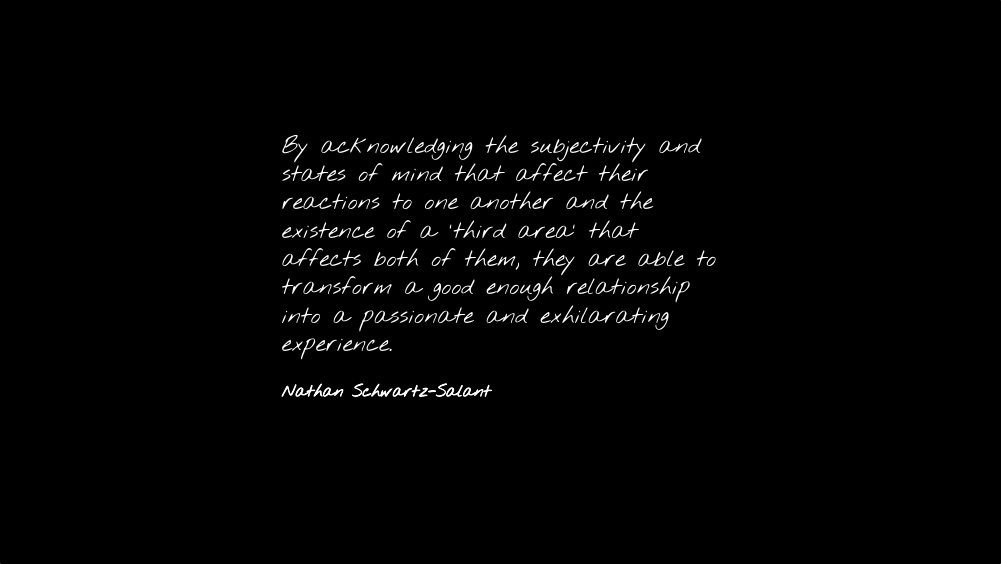
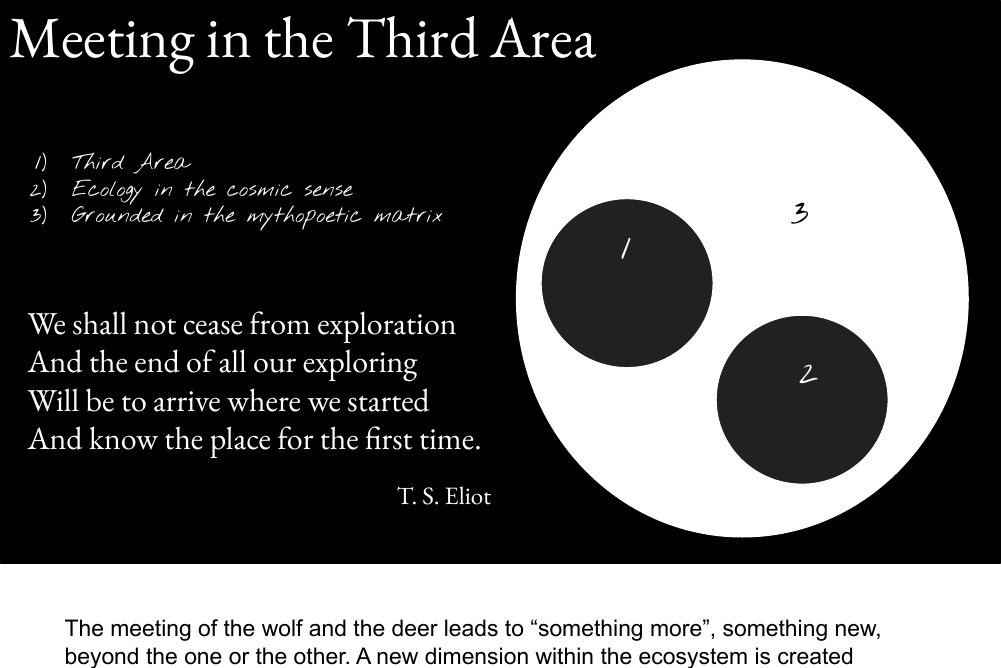
With regard to the very practical matter of how you can be happy in a relationship, Nathan Schwartz-Salant wrote this book, and practises this thing he calls the third area. To explain this very briefly, which I brought into my talk on human beings as a beneficial keystone species: he says that two individuals, one and two, always make up something which is the relationship. This could be your relationship to yourself, it could be your relationship to the cosmos, it could be your relationship to another person, but there’s always relationship. So when you’ve got one and two, there’s always a third. When that happens in a conscious way (and by that I don’t mean that everything that happens is conscious, I mean that you have a conscious interest in the tension of relationship), then you are in the third area, because you’re open to the whole aspect of shadow and shadow projections, and all the awful stuff that can happen when two people live together and they start saying, it’s you, you always do this, and then the other person says, no, you always do this. When this happens, we know that we are constellated in a third area, and if we’re willing to start working with those projections, we start to learn an awful lot about what’s actually going on in us, and not in the other person, which we first thought.
What I’ve done is, I’ve taken this idea of the third area and simply taken it out of human relationships into consciousness, and said that all human consciousness exists potentially in a third area. What that simply means is that there’s always an interactive field of self and other, of subjective and objective, and all the other paradoxes that we live with, and they can become a new thing. They can become a true enlightenment, when we are willing to engage in the tension of opposites, in the experience of paradox, not with the intention to quash one side of that paradox, but in order to allow it to live in a vitalising, enlivening kind of way.
So, if you want, Nietzsche’s idea and Weber’s idea and Corbin’s idea and Kingsley’s idea and McGilchrist’s idea are all the same. There are paradoxes: institution and agency, left and right hemisphere and so forth, and it’s not that one or the other is bad, it’s that they become bad when it’s one at the expense of the other. So my appeal, in the very basic sense, or the ethics that I’m proposing, is not one of good or evil, but one of holding the tension between opposites in order to explore the life-giving capacity that’s inherent in the paradox. The life is in the paradox.
I’m realising the time. I’ve been talking for over an hour, and I’m just about to break through into the Compass Rose of Consciousness, but if I do that, we would have to agree to go over time to have time to talk. So I’m turning to you to ask what’s the right thing. I think we have two choices. I can give you a very quick run-through of the Compass Rose of Consciousness, and we have a conversation that spills over the full hour, or we stop now and we leave this next piece for the next time. What do you think?
Claudius van Wyk: Michelle is suggesting that we do the quick review now. Let’s do the whole presentation, go through the full presentation. Don’t rush, just take us where you need to go. How are you doing, Chris?
Chris: I’m a little tired, but I think it’s good to continue, because we’re on the journey. I’m curious what’s going to come next. So, no, it’s okay.
Claudius van Wyk: Take your time, Marcus.
Joshua Malkin: I’m really enjoying it. I’m happy to go in either direction. Let’s go for it.
Claudius van Wyk: You’re on, Marcus.
Marcus Link: So, if you were to ask me how I arrived at this, I can’t tell you, because it simply arises out of my life and the way I’ve been thinking, that one day I suddenly thought: how about we map it like this? So I’m trying to explain to you now how I arrived at that creative thought, and why I think it’s such a big deal. This is why I’ve told you about these different thinkers and the paradoxes they talk about.
What I’m calling it is the Compass Rose of Consciousness, and I’m deliberately not just calling it the compass, but the compass rose, which is the old way of calling it, because a compass is just for metrics, but a compass rose is for wholeness. A rose is the entire thing, whereas normally we confuse a compass just with the direction we want to travel in, or want to identify.
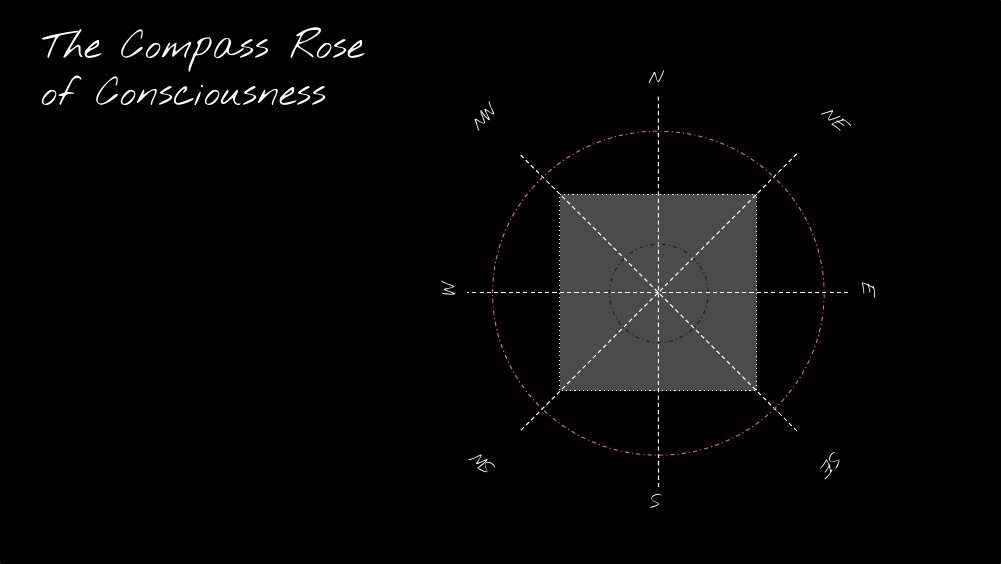
In my Compass Rose of Consciousness, just in order to make it easy to navigate, I’ve put down all the normal demarcations: north, south, east, west, north-west, north-east and so forth. Just easy, so that you know at the top is north, at the bottom is south, on the right is east. Easy, and it’s supposed to be easy.
Then let’s go right to the very centre of this compass rose. Let’s just call it the centre. There’s a little black circle a little bit further out. That black circle is there because that, for me, is the life-giving centre of the Compass Rose of Consciousness. I’m just going to leave it at that. We go further, and we have a little box, and at the end points of this box we have the point at which any particular direction of consciousness becomes unviable. It means it becomes somehow no longer in support of life; it undermines life. When we are further on the inside, we are closer to life, and when we go to the outside we get into the danger zone of the red circle, which is where we are in a very dangerous form of consciousness. It’s very much to the extreme of one particular direction of consciousness, and whenever we get into the extreme of one particular kind of consciousness, then we are also threatening our own life. If you want, the left hemisphere takes over, and it undermines life because it thinks it can do it on its own, but it actually needs the right. So there’s a balance point, and the balance point is one of life, and it sits at the centre. So far so good, I hope.
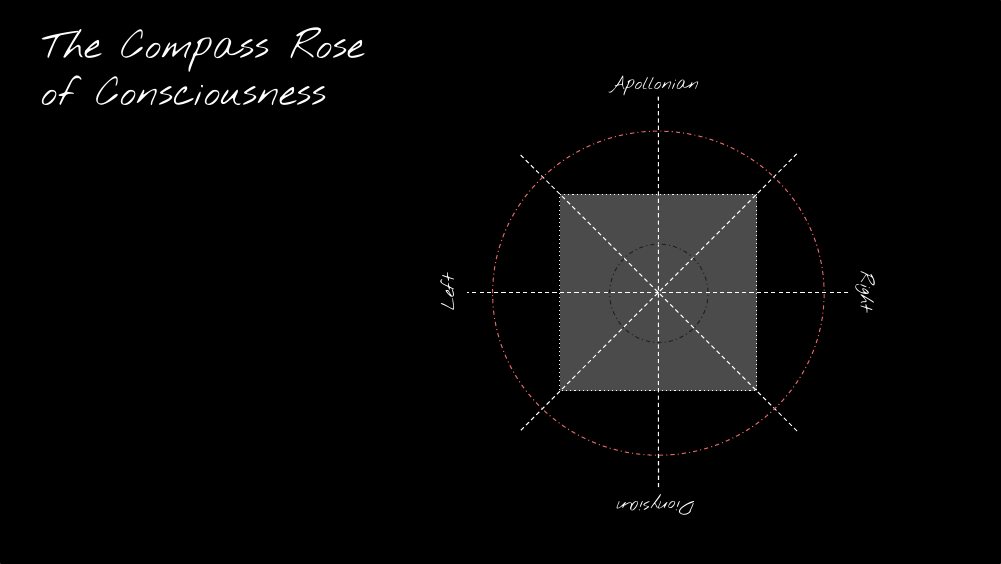
So, instead of calling it north and south, which is a bit counterintuitive (it’s helpful for navigation, but not for consciousness), I’ve now begun to fill it in. The horizontal east-west axis is left and right. The left is over on the left, or in the west, and the right is over on the right, in the east. This really means left-hemisphere and right-hemisphere consciousness structure, as it arises out of brain structure. And Iain McGilchrist is very clear: do not confuse this with functions. Left hemisphere and right hemisphere is not a function, it’s a mode of being. I’m not reducing consciousness to brain structure, but I’m saying there is a mode of being that emerges out of brain structure, just like my opposing thumbs allow me to hold tools. It’s a very real thing. The right hemisphere is a very real thing that enables a mode of being, and the left hemisphere enables a mode of being, and when they meet in the centre it’s life-giving, and when it goes over to the right it’s very dangerous, and when it goes over to the left it’s very dangerous.
Now, then we had Apollo and Dionysus, and we heard how Nietzsche said the tragedy of Western culture is when we lost the Greek tragedy, which was placing Apollo and Dionysus on the stage together, and that gave us structure and articulation and life and transformation, which Aristotle called catharsis. Why do we want to see grief in the theatre? Why do we want to see death in a theatre? Nietzsche says we want to see that because it touches us inside in a life-giving way. We don’t want comedy, we want tragedy, we need it. It’s important.
So we have Apollo, we have Dionysus, and they meet in the middle. We have the right and the left hemisphere, and they meet in the middle, and whenever they meet in the middle, that is life-giving.
I can see you zooming in on the screen, which tells me the writing is too small. Apologies, I’ll read it out to you. The grey box is supposed to demarcate an arena in which things are life-giving. So, on the Apollonian axis of consciousness, we’ve got radiant clarity. That’s a life-giving quality. On the Dionysian axis we’ve got ecstatic renewal; that’s life-giving, and you can have them together in a theatre play. On the left-hemisphere axis we’ve got discerning articulation. Have you ever had the experience that somebody says something and you go, wow, yes, that’s what I’ve always felt? Suddenly, through the articulation in words, your feeling becomes even more conscious. It doesn’t eradicate the feeling, it makes the feeling more. That’s life-giving. That’s discerning articulation. There might be better words, but I hope you know what I mean. And then, on the right-hemisphere side, we’ve got embodied wholeness. I think everybody knows the feeling of embodied wholeness, and, like the right hemisphere, it always comes with no words. You just have this feeling. You can feel embodied wholeness, and the left hemisphere can give you the words to express what you’re feeling, but it cannot feel that. That’s the job of the right hemisphere. So, inside our box, we’ve got some magic words, and those magic words are all making something possible. None of those words is saying I’m better than you. It’s saying I’m inside the space of vitality. It doesn’t have any claim to exclusivity.
Now we go to the other extreme. The Apollonian extreme that is unviable is, for example, bureaucratic stasis. You need to fill in another form, three times. No, you didn’t put your signature inside the box, it needs to be inside the box, otherwise the form is invalid and you’re going to have to fill it in. And actually you had to fill it in last week, not this week. You can’t plant those ten thousand trees until you’ve filled in all the paperwork in order to plant the trees. That’s bureaucracy gone mad.
Then, on the Dionysian axis, we’ve got the frenzied collapse, the chaos that is deathly rather than transformative. On the right hemisphere we have mystical dissolution. We are away with the fairies, to the extent that our magical thinking is taking over and we cannot engage with reality any more. This is, for example, some mental illnesses; they happen in the extreme. On the right, we are locked into our own interior world. Nietzsche very much had a right-hemispheric psychological condition, which he died of in the end. And over on the left hemisphere we’ve got hyper-rationalism. This is the left that is totally exclusive of anything else. It will not have anything else, it’s got to be rational and logical. This is Bertrand Russell when he tells Martin Heidegger that he just produces drivel and it makes no sense, and why would a philosopher want to write a poem, you can’t define your words. This is a hyper-rational exaggeration of truth, and it becomes unviable, which is why I’ve put it outside of the red circle.
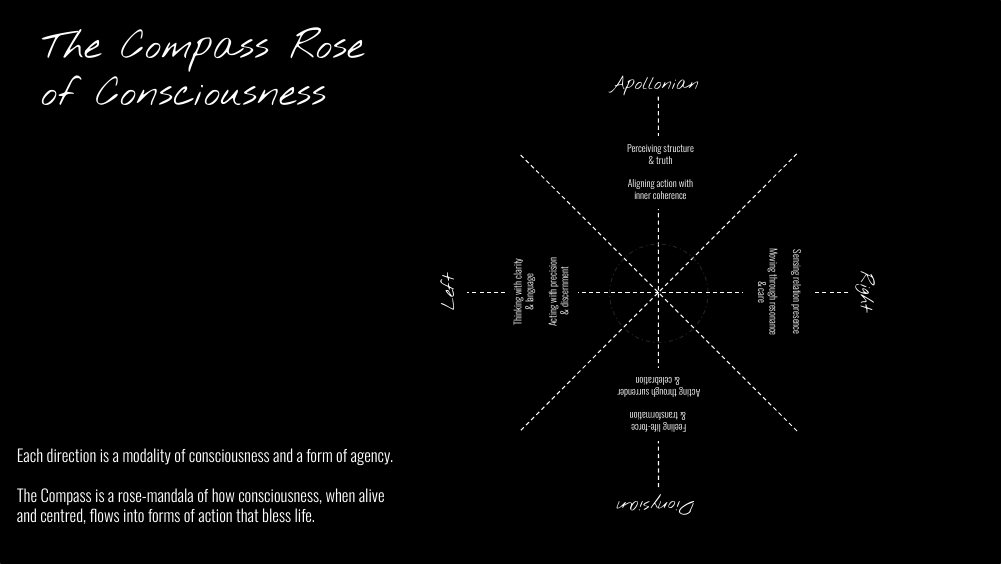
And as a final offering for today, I want to combine modalities of consciousness with forms of agency. So it’s like a sandwich: two good things, one way of experiencing life that leads to action, or forms of agency. I’m going to read them out to you, all around the Compass Rose of Consciousness, because for me it’s a mandala, or a rose mandala, of how consciousness, when alive and centred, flows into forms of action that bless life. So whenever you’re in a healthy tension of opposites, you can feel the life that is blessed through your actions, through the words you speak, through the ways you are, through the ways your life unfolds.
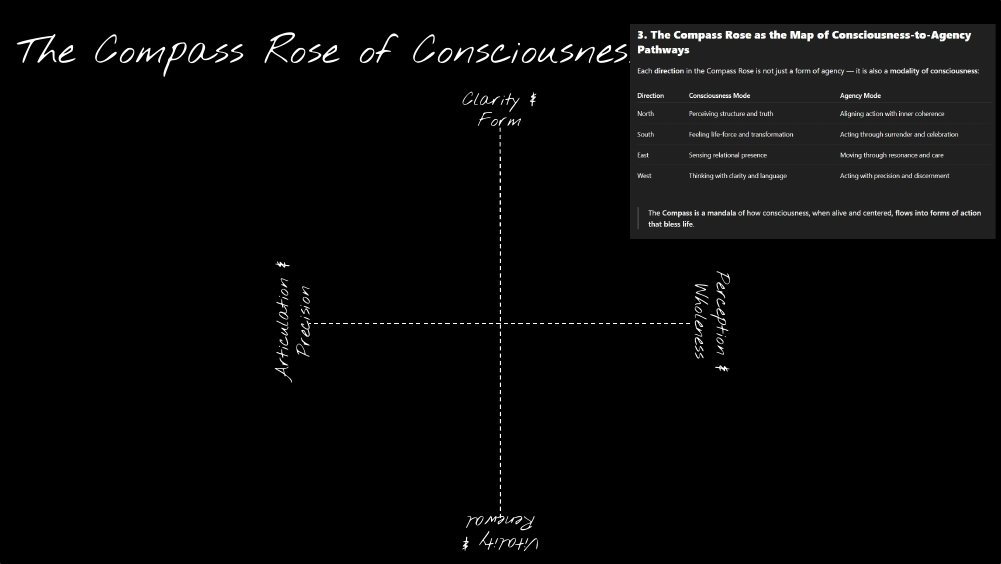
It starts up in the north, with the Apollonian, which gives us the ability to perceive structure and the sense of truth, and allows us to align our actions with a sense of inner coherence. That’s where conscience comes from. In the south, in the Dionysian, we’ve got a feeling sense of life force and the capacity for transformation, and that allows us to act through surrender and celebration. So that’s our Dionysian consciousness-and-agency sandwich. On the left-hemisphere axis we’ve got thinking with clarity and language, which allows us to act with precision and discernment. The right hemisphere gives us the capacity to sense relational presence. We can feel the presence of another person, we can activate empathy, we can have sympathy, we can have compassion; that all comes through the right hemisphere, and that allows us to move through resonance and care.
So this is when Ken Wilber’s four quadrants resonate with this experience of truth. This is the right hemisphere in full action; it’s allowing us to recognise something as truthfulness. You cannot have the Apollonian experience of structure and truth without the right hemisphere also supporting that. So you see how these things all interrelate, and it’s like your equaliser: it’s not that one is up and all the others are down, it’s that the music is playing at different frequencies across your equaliser. It has to do with your capacity to step into that centre and allow that tune to unfold, even if it’s sometimes a little bit uncomfortable, or really uncomfortable, but you’ve got the capacity to hold that. That’s what I’m trying to map with the Compass Rose of Consciousness. And I’m finished.
Just briefly, as a preview, what I want to do in the third session, if you can still bear with me, is to look at examples of placing different kinds of music, different kinds of languages, different kinds of cultures, different kinds of literature, different kinds of philosophy, different kinds of politics, all sorts of things, onto this compass rose, and always have a look: where does it spill over into that which is unviable, and where is it life-giving? The outcome of that is extraordinary. You can even understand why jokes are funny, which I’ll explore with you next time.
So, thank you for bearing with me for quite such a long time. It does take a lot of attention, and I’m most grateful for that deep attention you’ve given me. Thank you.
Claudius van Wyk: Well, I must say, Marcus, you kept me completely engaged the whole time. I didn’t drift away from you for a minute, and I’m sure you’re going to have lots and lots of reflection and engagement on the work you’ve done, and deep appreciation for the amount of soul you put into this. It comes through in the quality of life in your voice when you present it. It comes through in the quality of deep reassurance in what you’re offering. It’s almost as though what you’re talking about is that wonderful thing Ken Wilber said, the spiritual IQ and the self in resonance; it comes through in the way you present it. It comes through with a sense of deep coherence. So you kept me fully engaged. We can find the space to talk about this, but I think let’s have some response from who’s here.
Chris: I have a small question, Marcus, if I can. I can see, in the compass rose, the difference between the Dionysian and the right, but for the Apollonian and the left, that’s a bit more difficult for me to see, really the specificity. What is really the essence of those two, because they of course also have a lot of similarity? Can you say more?
Marcus Link: Yes. I would say that the origin of left and right is in what you might call the objective world of our biology, or neurology. We have a left hemisphere and a right hemisphere, and they lead to certain characteristics of how we are as humans. The Apollonian and the Dionysian is particular to the ancient Greek, or shall we say the Western tradition, Western culture, as a mythological way of understanding what left hemisphere and right hemisphere mean on the inside of your experience of life. When you’re enjoying a meal with friends, and you feel maybe the warmth of the candles or the fire, and the stars are out, you wouldn’t really say you’re in the right hemisphere, and you probably also wouldn’t say you’re in your Dionysian self. But when you look at the way Dionysus is explored in Greek myth, he is sitting with you at that table. He’s enjoying that food, he’s enjoying the companionship of the friends and the stars. And when you’re at work and you’re helping people, I don’t know how you go about work, but it’s always structured, and that’s an experience that’s on the inside. So, in a way, Apollo is an inner experience of the left, and Dionysus is an inner experience of the right. This is what I’m trying to map: that it’s always inside and outside. We will see next time how, in the tension between left and Apollo, you get some very interesting things that start to emerge, but also the left and Dionysus have some very interesting tensions that emerge. So I don’t think I can answer it much better, but I think it will become really alive through the examples that I’ll give. I think you just have to bear with me, and my intuition, for the time being.
Chris: Okay, yeah.
Marcus Link: Is that okay?
Joshua Malkin: Can I just say, Marcus, I really want to thank you, not just for the presentation but for your commitment on this journey, that’s obviously gone on a long time and has taken you a huge amount of effort and struggle in integrating all of these different aspects. It is an honour to hear this, because I’ve always wondered why I could not really find a way into Wilber, and I think what you’ve done is you’ve given me the reason. Because I’m someone who is very much about application, at least as much as purity (you know, the bridge as well as the pool), I think this is a hugely important contribution. It’s wonderful that, in a small way personally, and possibly in a larger way, Holos has made some kind of contribution, or been a space in which you’ve been able to bring this and develop it. I’m very much looking forward to the next one, and to looking at where all of these different elements exist within this map. Because I think maps, whilst they’re not the territory, we really need maps, and I’ve always worked with the idea of compass rather than ideology. This whole idea of wisdom that blesses life is wonderful, and it’s so interesting that it also fits not only with my own wrestling with the Abrahamic traditions, but also with my experience of the cosmological training with Native American cultures, in terms of the directions and the choreography. So I think it’s wonderful, and I’m going to study it more. I’m looking forward to hearing more. So, just to say, thank you, really.
Marcus Link: Thank you all for your reflections, and thank you in particular for a few things you’ve said there, Joshua. I want to acknowledge that my most important education in this part of my life has happened in the Holos group, I would say. This wouldn’t be possible without it. There’s something that was really deeply activated in the years of exploring things in the way we have.
And just as a little taster, just very roughly. I mean, there are many sub-traditions within Christianity and so forth, and Judaism, but this is roughly where they are positioned. And this is where you will find most indigenous cultures positioned. It’s a very interesting tension to explore how, essentially, the West has been moving up this axis, and it’s falling off the edge of the plate.
Joshua Malkin: And what’s on the other axis?
Marcus Link: Here? So you’d have, for example, Jan Smuts’s holism probably somewhere here, and you’d have Foucault’s deconstructivism probably somewhere here. You’d have a very interesting… when we look at politics, I can’t quite remember all of the placements, but it’s very interesting to find where they are on this map.
Joshua Malkin: Well, I look forward to seeing more of that.
Michelle: Okay, Marcus, thank you so much. I was riveted for every moment. I was really disappointed when it ended. Having recently been listening to Iain McGilchrist, and because it’s so fresh in my mind at the moment, I was actually experiencing it.
Claudius van Wyk: Great, Marcus, I loved every minute. I was really sorry that you finished; I could have listened for another hour. Having recently been listening to a lot of audio about The Matter with Things, his latest, and because it’s so in my mind, I was listening to you in your incredible way, how you have worked your right and left brain, going into this incredible interpretation and plotting of the territory of these different authors that you quoted, and then how you pull this into the precision of creating your compass rose. I’ve been intrigued at how valuable it has been observing you and reflecting on the description of McGilchrist, feeling that this is almost like the perfect relationship of the master and his emissary that I was experiencing through your presentation. So, in a way, when I listen to you, I have a sense of hope. It’s not only in the poetry of your language and the way you explain things; there’s something that happens for me when you share your wisdom that gives me a sense of excitement and hopefulness for the future, that I cannot pin down to a specific philosophy or a specific sentence. It’s the way you share the story that makes me want to be in the centre of this compass rose. So I’m so looking forward to the next session. Thank you.
Marcus Link: Oh, it’s a great honour. Thank you for the wonderful feedback. It might help to know that I’ve been writing this book for a long time, which I hope to finish this year, and this is a part of it. The book is called Keystones in the Patterns of Place, and the title is a reference to the possibility that human beings can be beneficial keystone species, as I once talked about. This book explores in great depth what I actually mean by that. In a nutshell, I come to the conclusion that there is an inner transformation that’s necessary in order to enable outer regeneration, and it is a journey that everybody essentially needs to go on themselves, because it’s different for everybody. And yet there are some similarities, of course.
I felt that whenever you write a book and put words together, it already starts to be not what you were actually thinking, if that makes any sense. So what I was trying to do is avoid what somebody explained to me is the ninth-chapter problem. The analysis is that most books are very good at analysing the problem, and then they have a very short ninth chapter in which they give a sort of idea of how it could be better, but it’s not really thought through properly. So it’s brilliant in the analysis over eight chapters, and then you have a very poor suggestion. I have split the book into four parts, and my hope was that the fourth part has some ways of thinking about ourselves by way of a navigational aid. For me, the compass rose is not an instrument, but a navigational aid. It helps us understand something, but using our imagination in a life-giving way. So, why am I feeling this opposition, or what’s going on here? That actually enables, for me, a transformation.
So, if ethics is a transposition of morality, then I think we’re talking here about a transposition of ethics into a form of becoming, where it’s not just our actions, but our whole life becomes a seed. You don’t know what’s all going into the seed, but the imagination is that life comes from a seed. So my whole life is charging the seed with the possibility that there’s going to be some life-taking things in my seed, definitely, but I also hope there are a few life-giving things in the seed that I’m becoming, and that the futures that grow out of each and every one of us can be more life-giving. So that, for me, is a poetics that transcends an ethics. Morality is like good and bad; ethics is that you have a choice, it’s connected to your conscience; but poetics is an understanding of your life being a thread in a greater weave, and it’s the attitude with which you allow yourself to be woven into the fabric that makes a difference as to whether it’s a little more life-giving or a little less life-giving. That’s what’s underneath this. And I’ve just been trying to find ways to say this in a way that isn’t the traditional ninth-chapter problem.
Claudius van Wyk: So this seeing of life-giving: Michelle, you responded to that in the giving of hope, and I think that is also something that is so dear to [unclear], creating this space for hope. So, deep appreciation for what you’re doing. My sense is that we don’t want to rush this out into the public yet. My sense is that we give you the time and space to bring it in the way you can bring it for now, and we will want to think about what kind of bite-sized pieces folks will be able to stay with, in a way that they can take meaning from it, because it is so rich and diverse and deep. I’ve got no idea about that; we want to talk about that. And maybe, before we do the next presentation, Marcus, because I’m thinking aloud, Josh, maybe we actually have that conversation, so that your next presentation is talking into an experiment of how this could go into the broader public. Chris?
Chris: I just wanted to add something that really resonated, and that was when you said this thing that, in our Western culture, we’ve made of time a bubble, and we don’t have a past and no future, very different from indigenous people, and that we don’t have initiation. That resonated, really. I think that’s really the core of our problem, this lifelessness in which we live, combined with the institutionalisation of our lives. It’s very difficult to escape from that. You nearly have to get out. Of course, you can go into your inner process, but I think we also have to get out of that system, because that’s the only way to retake our life and our soul, in a way. I found that was like, whoa, yeah. We often think that in the Western mind time is important, but we’ve done something really strange with time. If you look at indigenous people, they have a far longer view: they can position themselves in a past, and they have a future, and they often also have long-term views on what will happen, I don’t know, thousands of years into the future, and a thousand years into the past. Although they often have only oral, collective consciousness, like a library, they have a far bigger knowledge of where they are and where the earth is, in which we are really made completely dumb. Yeah, that’s really… yeah, among all the rest. Thank you.
Marcus Link: Thanks for picking up on that; I agree with you. I’ve seen in many cultures how it’s so wonderfully different, and yet what they all have in common is that they know where they come from, and that every single act, every sunrise, every meal, is placed within this cosmic mystery that they’re a part of. And we don’t have that in the same way.
Claudius van Wyk: So, Joshua, just your thoughts. Do we have a conversation around how to roll this out before Marcus gives this third piece, so that that’s an experiment in itself, or do we just go through the whole thing, giving you all the space you need, and then we have that conversation?
Joshua Malkin: I’d be interested to know what Marcus feels would be helpful to him. I also think there’s so much in this even to begin digesting parts of it, as well as the overarching cosmic perspective. What would be helpful for you, Marcus?
Marcus Link: The reason I didn’t want to speak in a public situation is because it makes me uncomfortable, in a way that means I don’t feel I can speak quite from that liberated place that Michelle has commented on a few times. It feels like I’m now speaking for some imagined schoolmaster, and I have to get it right in some way, and it loses the life. So I’m very grateful for a very small group, because it actually means my ability to be is different. I noticed that when I started today, I did start off in the place of feeling in a classroom, although none of you gave me that feeling. It had to do with the fact that I told a couple of other people what I was going to do today, and in trying to explain to them the magnitude of what I’m talking about, I entered that space of seeing their eyes glaze over and all this stuff. So for me, I don’t know the answer. I know that the only way to approach it, for me, was to go through this process of: this is a rite of passage, this is an initiation into when we don’t know. So I can’t help you, Claudius. I think it’s a very good question, but I…
Claudius van Wyk: Where my mind goes now is, I’m withdrawing that thought. My sense is, let’s just stay with your process. We’ll set the public aside; let’s stay with your process, and when you’re ready to come with a third piece, we just give you the full space.
Marcus Link: Yeah. I don’t remember which president it was, but there’s this quote: if I’d had more time, I would have written you a shorter letter. I think that’s what we’re doing here, we’re moving towards the shorter presentation.
Chris: I can just say that I’m really looking forward to the next chapter, the next piece, indeed. As you say, you’re going to give a lot of examples, to be able to really put it all together more. So, yeah, I’m looking forward to that, whenever you’re ready.
Marcus Link: Yeah. I imagine, give me four or five weeks or so, so I can also do all the slides. I think that’s quite important, also for me. I notice that when I see slides I haven’t spent a lot of time on, I know less what to say. So I just need to go through it. Good, great. Why don’t we do that, Claudius?
Claudius van Wyk: Okay, that’s the way we’ll do it. You tell us when you’re ready. Take all the time you need, because what you’re doing is hope for humanity.
Marcus Link: Thank you for all your very big words, all of you. It’s much appreciated. I genuinely feel it’s a very small contribution, but it’s coming from a very joyful place. Thank you.
We took a recording last time, and this time, and I’ve been using the transcriptions, because there are some things that you’ve said and that I’ve said that are actually very meaningful. So, do I have your permission to do that? There’s no personal reference; it’s just for the research, if you want. The second thing is, in some future situation (and I would ask you formally), but just sensing with you now how you feel about it: if there was an opportunity to put the three videos on a website, where we cut out the question and answer, so it’s more about the presentation, not about me, would you be okay with that? And we should maybe, if you like, do that on the Holos website as well. But just, maybe not. Just, thank you very much. That’s it from me. Big thanks again, I’m really honoured. Thank you. Bye.
Claudius van Wyk: Thank you. Same.
Questions & answers
Why does Marcus say spiritual intelligence 'deals in absolutes'?
Wilber counts spiritual intelligence as one of eleven intelligences, and it is the only one that trades in absolutes rather than in relative, contextual truth. That is why arguments that look merely practical turn out to be so charged. Take the quarrel between vegans and carnivores, which I meet constantly in farming: on the surface it is about diet, but underneath it is an absolute question about life, death, purity and violence, so any compromise feels like betrayal. When something touches our sense of life at that depth, we cannot help being forceful.
What does Max Weber mean by disenchantment and the iron cage?
Weber describes the whole arc of Western culture as a long disenchantment, a world in which mystery has been traded for calculation and we come to believe that everything, in principle, can be measured. The end of that road he calls the iron cage: we have gained institutions and lost agency, pouring our life energy into jobs and economies that leave us without purpose. His answer to his Munich students was not to glorify work but to find vocation, the purpose you have to declare for yourself because no institution will hand it to you. He thought this leaves modern people as, in his phrase, specialists without spirit and sensualists without heart.
What does the Goethe line about 'the lessons of three thousand years' mean in this talk?
The lines are Goethe's, from his West-Eastern Divan, and I translated them myself: who cannot account for the lessons of three thousand years may stay in the dark, uninitiated, and live from day to day. At first I heard only a schoolmasterly scolding in that, as though I had been set homework. I have since come to hear the opposite. Without a sense of where we stand in time we live in a flattened present, with no past and no future, and the initiation Goethe points to is really an initiation into our own agency.
How does Marcus answer the idea that indigenous cultures are an earlier stage of development?
That is exactly where Wilber's ladder troubles me. If development is only a climb, indigenous cosmologies show up as lower rungs, and that does not match my experience of them at all. When I listen to Tyson Yunkaporta I do not hear someone at an earlier stage; I hear someone with access to something we have mislaid. His point is that you do not need Aboriginal knowledge as content, you need to remember your own ancestral knowledge, which turns development from climbing higher into remembering deeper.
What does the Compass Rose of Consciousness add that Wilber's ladder cannot?
Wilber gives us a magnificent vertical ladder, but a ladder only goes up, and what we have lost is not only height. It is depth, balance, cyclical movement, the two hemispheres kept in relation. So I have been working towards a compass rose of consciousness: a dynamic field with a north-south axis of Apollo and Dionysus and an east-west axis of the right and left hemispheres, each direction life-giving near the centre and deathly at the extreme. I call it a compass rose and not a compass because a compass is just for metrics, whereas a rose is for wholeness, and it is meant to orient you from inside the territory rather than set you on a rung.
What is the Compass Rose of Consciousness?
It is the picture I have been drawing towards, two axes crossing at a living centre. The east-west axis holds Ian McGilchrist's two hemispheres, the right and the left, and carries the structural, outer side of things. The north-south axis holds Nietzsche's Apollo and Dionysus, order and ecstasy, the inner and felt side. Each direction is life-giving near the centre and turns deathly at its extreme, so it works as a compass that orients you from inside the territory rather than a ladder that sets you above or below.